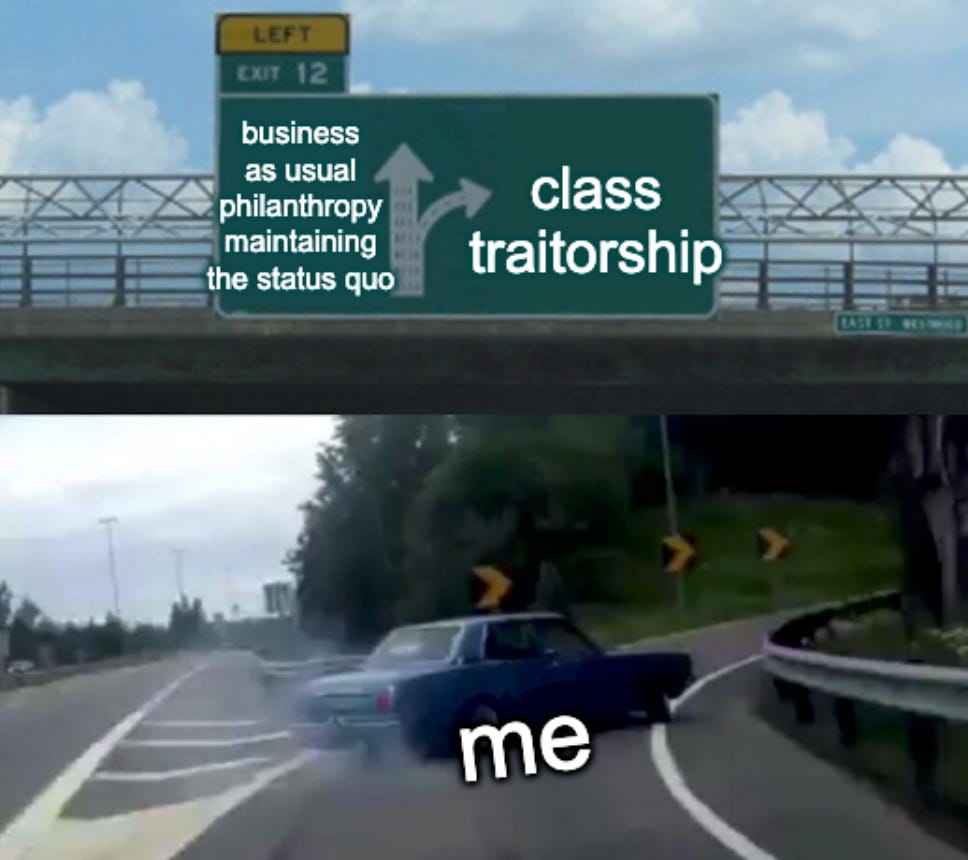
Why the Most Dangerous Thing You Can Do With Privilege Is Keep It
On Being Called a Traitor and Saying Thank You
I first became interested in class traitorship because I had already been called a gender traitor and of all the slurs I’ve received as a queer person, I found this one tasted less like an insult and more like freedom. To betray patriarchy, to walk away from the tight inheritance of toxic masculinity, to refuse the script of heteronormativity, these were not losses. They were instinctively correct states of being. The people who called me traitor meant it as a putdown. I received it as a reflection of their internalised distortions, not mine. So when I later encountered the term class traitor, I remembered that sometimes the accusation is a map. It tells you exactly which structure you have stopped serving, exactly which master you have disappointed. The question became: what other allegiances needed betraying? What other comforts need walking away from? What if the queer art of dis-allegiance, the refusal to love what you were told to love, was transferable? What if it could be applied, toward the owning class, toward those with way more than is humanly needed?

The Original Betrayal
To speak of class traitorship is to immediately confront a definitional violence. The term itself presupposes a primary allegiance, a motherland of economic position to which one naturally belongs and to which one owes faithfulness. But what if that belonging is the original betrayal? What if allegiance to one’s class position, particularly when that position is secured on the backs’ of others and the plunder of a planet, is already a treason against something larger, older, and more real than any tax bracket? This is the inversion at the heart of any serious wealth-class analysis: the recognition that the “we” of class solidarity is a cramped and ultimately suicidal fiction when it excludes the ecological and proletarian commons upon which all life depends.
The Seduction Problem (Making Treason Desirable)
We must be honest about a key strategic failure. The left has largely made class traitorship sound like a punishment. Renunciation. Guilt. A lifetime of joyless penance and apologetic eye contact. This is a disastrous framing. The wealth defence industry, with its army of accountants, estate planners, philanthropic advisors, and family office consultants, protects concentrated assets from redistribution and it understands desire. They make retention seductive. They sell legacy, safety, dynastic fantasy, the warm narcotic of intergenerational control. If we are to build functional allyship with those in the wealth class who might yet choose differently, we must make class traitorship more seductive than what it betrays. Not easier. Not comfortable. But alive. We must make it clear that what you lose in allegiance you gain in belonging, to a project larger than your name, to a future your money cannot buy, to a selfhood unhaunted by the knowledge of what your comfort costs. As Resource Generation’s Money Stories toolkit insists, the question is never just what are you giving up? but what are you coming home to? The class traitor does not simply renounce; they rejoin. They trade the gilded isolation of private wealth for the messy, muscular solidarity of the commons. That is a better offer. We need to say so.

You Have Been Programmed
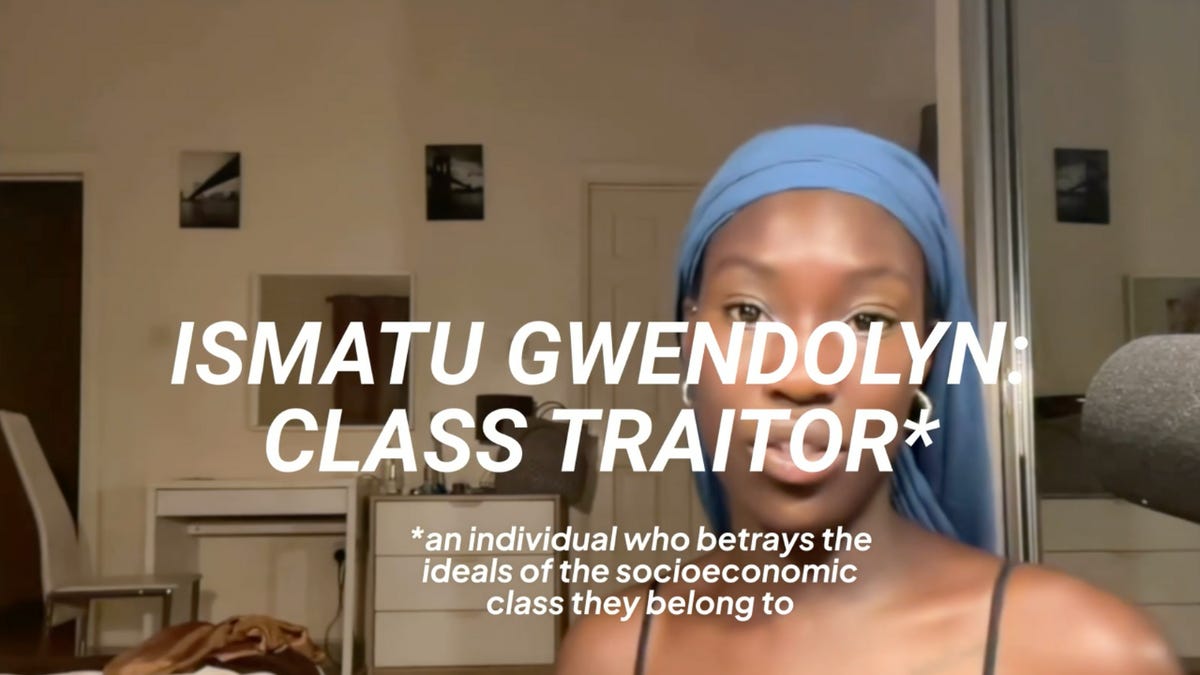
The clinical dimensions of this work are rarely given their due. ismatu gwendolyn, offers a crucial insight when they identify the ways capitalist arts train our neural pathways, literally rewiring our brains, to perceive individual wealth accumulation as collective victory. To break this trance requires something closer to deprogramming than to political education. It requires understanding that your brain has been colonized by a story about success that is slowly killing you and everyone you claim to love. This is where the psychological labour of class traitorship becomes indistinguishable from what we might call, with apologies to Deleuze and Guattari, a schizoanalytic project. Deleuze, in his late essay “Postscript on the Societies of Control,” wrote: “There is no need to fear or hope, but only to look for new weapons” (Deleuze, 1992, p. 4). The weapon here is not a doctrine but a dis-allegiance, a deliberate unraveling of the identitarian ties that bind you to your class position. Deleuze and Guattari understood that capitalism operates not merely through repression but through the production of desire itself, we are made to want our own enclosure, to libidinally invest in the very structures that extract from us (Deleuze & Guattari, Anti-Oedipus, 1972). The class traitor, then, is engaged in something more intimate than political realignment: they are engaged in a reprogramming of desire, a reorientation of what feels like home, like safety, like a good life.

Psychological Costs of Dis-Allegiance
This is devastating work. To betray your class is to become illegible to your family, your colleagues, perhaps even to earlier versions of yourself. It is to sit in rooms where the casual language of inheritance, investment, and property value circulates like a shared mother tongue and feel yourself going mute. It is to recognize that the comfort you were promised, the comfort you may currently inhabit, is structurally dependent on the discomfort of others, on the slow violence of extraction zones you will never visit, on supply chains that disappear human hands into the smooth surface of commodities. The class traitor does not get to feel righteous about this knowledge. They get to feel implicated. And then they get to act.
Resource Generation’s Money Stories (2019) offers a practical companion to this grief. The toolkit is built around facilitated storytelling, young people with access to wealth narrating their relationships to money, inheritance, and justice, and it treats the emotional labour of dis-allegiance as central to the political work. One cannot redistribute what one cannot first face. The stories in Money Stories reveal a recurring pattern: the moment of rupture is rarely ideological first. It is relational. Someone loves someone across a class line. This is not weakness. This is how the cage door opens, through the heart, not the doctrine.

The Liberal Trap
What separates the class traitor from the merely guilty liberal is precisely this question of action. Gwendolyn, drawing on James Forman, draws a sharp line between the revolutionary who seeks to seize and transform power structures and the liberal who endlessly discusses change while preserving the conditions that make change impossible. Liberalism, in her devastating formulation, is “the refusal to engage in principled ideological struggle” (Gwendolyn, citing Forman, The Making of Black Revolutionaries, 1972). It provides the aesthetic of radicalism without the substance, the black square on Instagram, the land acknowledgment before the keynote, the diversity and inclusion initiative that leaves the policy untouched. The class traitor, by contrast, understands that true radicalism is easily identified because it always meets institutional pushback. If the system is not threatened by your art, your career, your philanthropy, your speaking fees, then whatever you are doing, it is not class treason. It is interior decorating.

Sankara’s Necessary Traitor
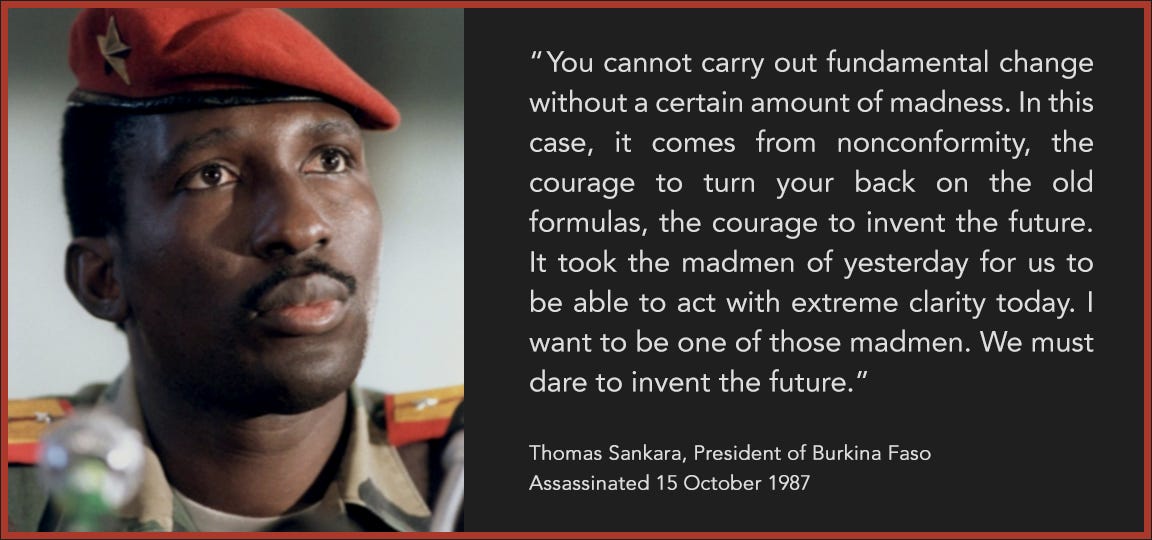
And yet: class traitors are not the vanguard. Thomas Sankara, the revolutionary president of Burkina Faso, understood this with characteristic clarity. He did not believe the revolution would be won by class traitors, the masses would win it, or it would not be won at all. But he insisted that class traitors were necessary to any revolutionary process. The trained professional, the doctor, the engineer, the agronomist, the lawyer, who turned their training away from private accumulation and toward the people’s project was not a romantic figure. They were a logistical one. Sankara’s government actively recruited such figures, not to lead the masses but to serve them, to place their expertise at the disposal of collective liberation rather than individual enrichment. This is the precise calibration the class traitor must hold: not saviour, not vanguard, but resource. Not the architect of the revolution, but someone who shows up with tools and asks where to swing.
This reframing matters strategically. The wealth defence industry depends on making the owning class believe they are the protagonists of history, that their genius, their risk-taking, their vision is what builds the world. The class traitor refuses this script without swinging to the opposite fantasy of abasement. Sankara’s model offers a third position: the traitor is useful, necessary even, but not central. The work is to hand over the tools and then to follow, not lead. This is the humility that distinguishes solidarity from philanthropy.
Weapons, Not Possessions
Here we arrive at the crux: class traitorship is not a performance of renunciation. The goal is not poverty as moral theatre. The goal is the strategic redeployment of resources, financial, social, cultural, cognitive, toward the destruction of the conditions that produce wealth on one side and immiseration on the other. This requires a theory of redistribution that is material, not symbolic. It means looking at your salary, your assets, your networks, your platforms and asking: what would it mean to treat these not as possessions but as weapons? What would it mean to redirect them not toward the reproduction of your own comfort but toward the construction of a world in which that comfort is no longer structurally dependent on someone else’s precarity? As Gwendolyn insists, this is “never really a question of whether people are able, it’s a question of whether people are willing“ (Gwendolyn, “Class Traitor,” threadings 2024).

The Frame Is Planetary
The planetary dimension of this work is not a nice add-on; it is the frame. There is no meaningful class analysis that stops at the human. The working class is not a species apart from the web of life; the proletariat breathes air, drinks water, depends on pollinators, and is already dying from the metabolic rifts that capitalism has torn through the biosphere. To fight for the working class without fighting for the conditions of life itself is to defend a body while poisoning its bloodstream. Class traitorship, understood planetarily, is the recognition that the hoard is not a harvest, that what the owning classes have accumulated is not wealth but a massive and lethal subtraction from the commons, ecological, social, psychic. To betray that class is not to lose something. It is to begin the long work of giving back what was never yours to take.

Living Inside the Question
None of this is comfortable. The psychological terrain of class traitorship is marked by grief, isolation, and the constant temptation to retreat into the warm bath of liberal respectability. It is easier to recycle, to buy ethical chocolate, to cry during a documentary, to post a quote from Fanon or Federici, than it is to look at your own material position and ask what it would cost, in relationships, in identity, in felt safety, to genuinely sabotage the structures that prop you up. The class traitor does not get to skip this question. They get to live inside it, which is another way of saying they get to live inside the truth.
This is the alliance that matters: not the cheap solidarity of the charity gala or the impact investment portfolio, but the slow, unsexy (nay horrifying) and psychologically grueling work of allying with the proletariat and the planet against the class that raised you. It is a betrayal that is also a homecoming. You were never meant to love your inheritance more than your world.
The work now is to make this treason irresistible. Not just easy, but irresistible. Because the wealth defence industry is organised, well-funded, and seductive in its own right. It whispers permanence. It sells dynasty. It promises that your name will outlive you, carved into a building that houses the very inequalities you might otherwise have fought. Against this, we must offer something older and more electric: the chance to belong to something larger than your name, to die as a class and be reborn as a person, to trade the gilded isolation of private wealth for the living, breathing, difficult solidarity of a world worth inheriting.
The revolution will not be led by class traitors. But it needs them, not as saviours, but as resources; not as architects, but as backers. The question is not whether they are able. It is whether they are willing. And whether we can make willingness feel less like a funeral and more like a rebirth.