The Class War’s Unlikely Recruits: A Field Guide to the Defectors
We are drowning. Not in water, though the coasts will probably claim that terrain soon enough, but in a sea of sentimental propaganda about the wealthy. Every day, the screens offer us the same absurd theatre: a billionaire descending from a spacecraft he built with exploited labour, or a union-busting CEO smiling at a philanthropic gala, or a tech founder explaining, with the earnestness of a missionary, how his new app will totally disrupt poverty. The assumption, never stated yet always present, is that the rich are a different species, either saviours to be worshipped or monsters to be merely resented. Both reactions seem useless. Both are forms of passivity moonlighting as political opinion.
Michael Gast has spent twenty years refusing this binary.
Let me say this plainly, because Gast insists on it: organising the rich is not the key project. You will find no Leninist fantasy here of a benevolent bourgeoisie leading the masses to salvation. The key project remains the organising of the multiracial working class, the people who clean the billionaires’ toilets, drive their children to school, and will, if history allows, inherit the earth they have scorched. The organising of the wealthy is subordinate, instrumental, and entirely accountable to that larger struggle. It is the extraction of resources from an enemy camp, nothing more. And yet, to refuse this work, to leave billions on the table out of aesthetic purity, is not radicalism but sociopolitical suicide.
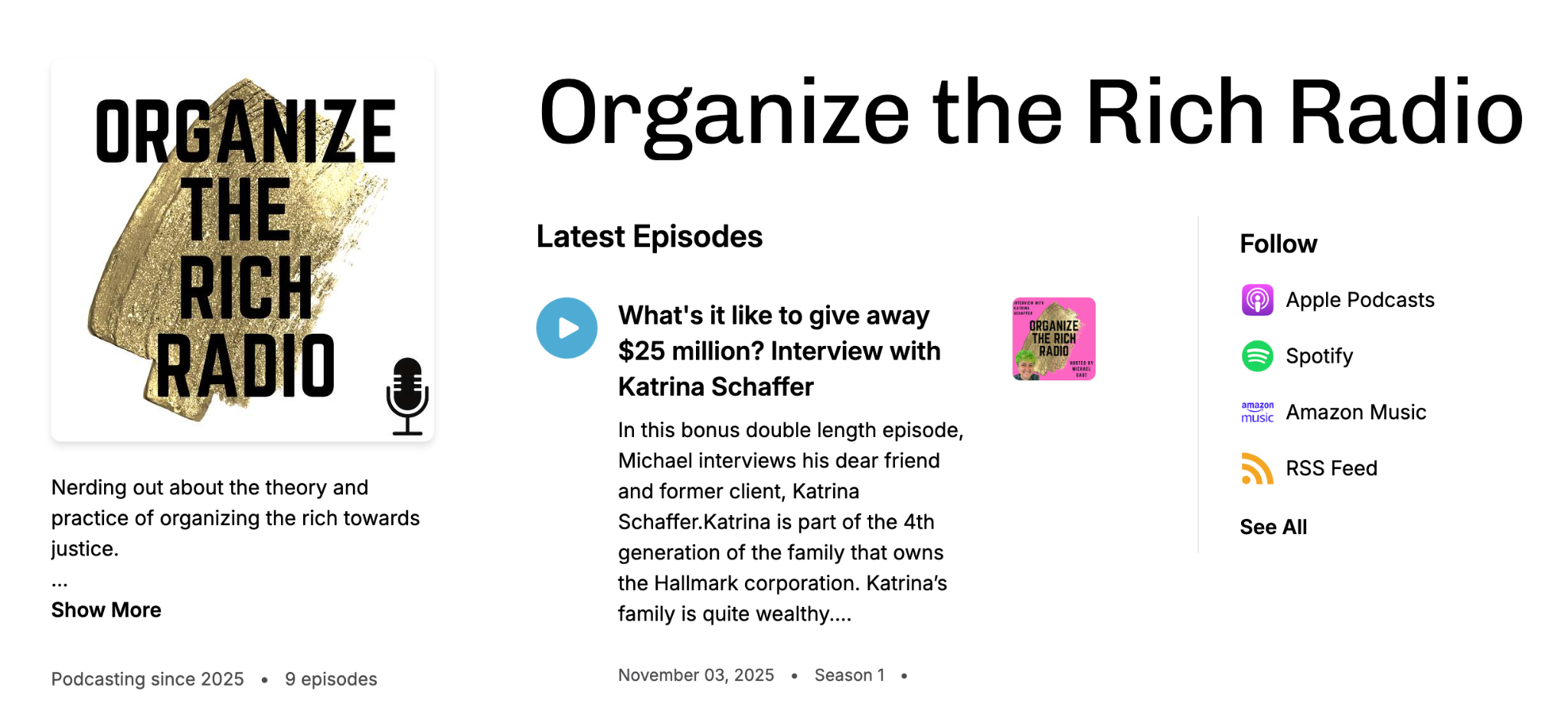
What Gast has documented, across fifty years of obscured lineage, is the quiet emergence of something unprecedented: a network, now numbering perhaps a hundred thousand wealthy individuals, who are organised not to give back but to give away. This distinction is everything. Philanthropy, as Anand Giridharadas has surgically demonstrated, is largely a reputation-laundering scheme, the rich funding the salad bar while their lobbying firms burn down the kitchen. Gast points to a different creature: the inheritor who moves $25 million to climate justice with no expectation of a tax break, who states openly that her goal is “to end her own dependence on inherited wealth”. These folks are not to be seen as saints. They are defectors. And in a class war, you do not refuse defectors, you arm them and put them to work.
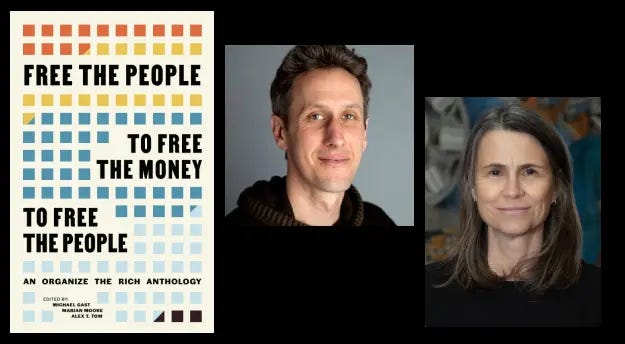
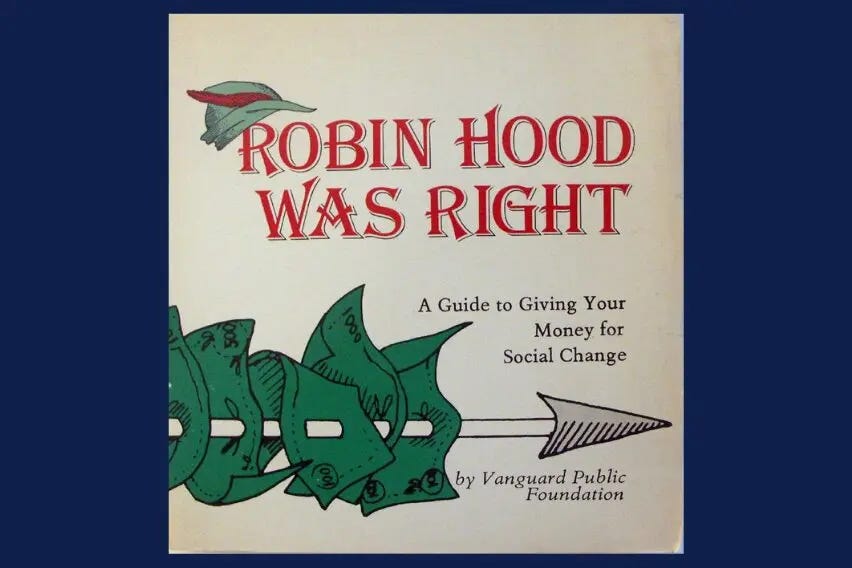
The anthology, Free the People to Free the Money to Free the People, is the most comprehensive map of this territory that I can find. It contains the voices of those who have tried, failed, learned, and tried again, from the radical rich kids of the 1970s who passed around the pamphlet Robin Hood Was Right, to the cross-class coalitions of the present moment. It is not a comfortable read. It insists that the wealthy who wish to be useful must stop performing poverty, must name their access, their capital, their power, and then place it on the table as a weapon. As Gast himself writes, in a passage that should be tattooed on the inside of every progressive donor’s eyelids: “To claim our class positions, and to claim the relationships and the power and the access that it enables for us, is actually really helpful”.
Sentimentality is the enemy. Guilt, a luxury. The planet is burning and Mars colonisation plans are in place for the 0.001%. Free the people to free the money to free the people is more than a credo, it is a sequence of political operations and should be read as such.
The Unprecedented (and Deeply Suspect) Formation
Are we seeing an unprecedented movement of the rich towards justice? After decades of watching the Mink Brigade, the Funding Exchange, and the rise of Resource Generation, Gast’s answer is a tentative, qualified, politically sharp: Yes.
I am not talking about the glories of philanthropy. I am not praising the “generosity” of the righteous rich. Anand Giridharadas has already surgically dissected the Winners Take All charade, the liberal elite who fund the circuses while hoarding the bread. Philanthropy is, more often than not, a reputation laundering scheme. But Gast points to something else: the emergence of an ecosystem of at least 100,000 wealthy people, representing tens to hundreds of billions in assets, who are organised not just to write cheques, but to end their own class power.
This is the distinction that matters. And it is worth repeating, as it is the difference between virtue-signalling-charitable-giving & justice-based redistribution, the difference between giving back and giving away, (and then ceasing to exist as a class agent of inequity).
The Map of the Insurgency
Gast has drawn the map of this territory. He delineates the landscape where donor organising meets political engagement. He points to the Trust Web, where inheritors like Elspeth Gilmore (of the Publishers Clearinghouse fortune) give millions in no-strings-attached gifts to organizers, not for a tax receipt, but for the revolution. He points to Katrina Schaffer, of the Hallmark corporation dynasty, who has moved over $25 million of her personal wealth to climate justice and electoral organising, with 60% of that money receiving no tax break. Her goal is not to be a wealthy patron; her stated goal is to “end her own dependence on inherited wealth”. He points to Monica Simpson who talks about pivotal moments that taught her to see the humanity in people across class divides, the spiritual dimensions of money and survival, and why showing up at uncomfortable tables is crucial for movement building. We must commit hedging our connections in further expanding this map of insurgency.
This is the surgical strike. To free the people, you must free the money. To free the money, you must free the people holding it from the delusion that they are entitled to it.
The Aesthetics of Class Collaboration
But let us not fetishize this. The left has a sick relationship with class. We waffle between the fetishization of the “noble martyr” worker and the dismissal of the working class as irredeemably conservative. We assume that the only way to fix the world is to find a tech bro with a PhD to engineer a solution (The Gates Foundation, take a bow).
Gast insists on a hard, materialist truth: you cannot win a class war if you refuse to admit the existence of defectors from the enemy camp. “To claim our class positions,” he writes, “and to claim the relationships and the power and the access that it enables for us is actually really helpful”. We must stop the middle-class performance of poverty. If you have access, say you have access. If you have capital, put it on the table. Strategy requires honesty, not aesthetic purity.

From the 70s Counterculture to Today
In 1977, a pamphlet was passed hand-to-hand in the shadows of the movement: Robin Hood Was Right. It was a roadmap for rich kids with guilty consciences who wanted to blow up the system from within. That lineage has now culminated in the 2025 anthology, Free the People to Free the Money to Free the People.
Gast admits the work is incomplete. “For too long,” he confesses in the book, “we have been satisfied being the rebellious rich without being connected to the labour movement or part of a real plan for winning power for working people”. This is the confession of a strategist, not a moralist. The “rebellious rich” are merely a vanguard of a single battalion. The war is won by the infantry of the poor.
We can safely say, a majority is drowning in a late-capitalist hellscape. The planet is burning and the billionaires are building apocalypse bunkers. Sentimentality is useless and guilt is paralysing.
Organizing the rich is all about extraction, a seemingly benevolent form (if there is such a thing). It is about convincing the class enemy to liquidate their own position. It is a dirty, compromised, necessary piece of the puzzle. If we refuse to take their money, they will use it to fund our opposition. If we refuse to organise them, they will remain organised against us.
As Gast says, we need to “strike a balance between being welcoming and accepting, while also pushing people to shift money and power“. The velvet glove on the iron fist. The soft pillow and the Marxist/Leninist critique.
Take the money. Take the access. Free the people. Or choose a different path, it will indeed take many of us hacking at the roots of injustice from all possible angles to bring about a deeper, lasting change. And quite importantly, find the cool class traitors, for as Sharon Chen, says “who’s going to reach my people but me?”
Note: This essay draws heavily on the work and writing of Michael Gast, strategist for Solidaire and editor of the “Organize the Rich” anthology.

References
1. Michael Gast. Organize the Rich Radio. Apple Podcasts; 2025 [cited 2026 Jun 11].
2. Michael Gast Oakland, CA: Solidaire Network; 2026
3. Free the People to Free the Money to Free the People: An Organize the Rich Anthology 2025
4. Robin Hood was right, a guide to giving your money for social change.
5. Giridharadas A. Winners Take All: The Elite Charade of Changing the World. 2018.
6. Solidaire Network. Michael Gast has been involved in organizing rich people for social justice for over 20 years
7. Michael Gast New York: The Nation; 2026