In May 2026, fifty organizers, funders, and activists from across Europe and beyond gathered for a powerful conversation (recording here) that I was honored to convene on behalf of Belonging Beyond Borders in partnership with the Guerrilla Foundation. It was a rare opportunity to hear directly from two leading organizers in the US who are confronting violent migration enforcement tactics head-on, building belonging across deep divides, and protecting the communities most under threat. I came away inspired, with three takeaways I want to unpack in what follows:
- Migration is the wedge, and the testing ground of authoritarianism, on which democracy itself is being won or lost. It is not a side issue that anyone concerned with social justice, democracy or ecological flourishing can treat as someone else’s concern.
- The mechanics of enforcement is a battle of infrastructure and narrative, not just policy, infrastructure that organizers can contest and defund before it hardens into place, and narratives can be challenged and rewritten.
- The movements that are growing a wide base meet people where they are and distribute risk rather than concentrating it on the most vulnerable. They need funders willing to back this slow, relational, hard-to-measure work rather than retreating from it.
In a time of closing political space and much of philanthropy in retreat around migration, this was a welcome chance to hear bold visions from people building another reality in real time. If that speaks to your work, read on, and get in touch to collaborate.
The headlines coming out of the US tell of mass detention and deportation, a $170 billion immigration enforcement budget passed by Congress in 2025, and the murders by militarized federal agents of both migrants and migrant justice protesters. These are policies enacted against real people – parents, neighbors, friends, coworkers. At the same time, another story is missing from the headlines: the ways communities across the US are organizing with extraordinary sophistication, and, in measurable ways, winning. This is the story that needs amplification around the world. Our strategies for a life-affirming, democratic future cannot afford to live inside of borders, as the authoritarian playbook in the US borrows tactics from Hungary and China, and is being mimicked in Germany, South Africa and beyond. Our collective hope, imagination, and capacity to resist are strengthened each time we are reminded that we are not alone and that our kindreds are already creating the world we need right now.
The two practitioner-leaders at the heart of that session were Silky Shah, Executive Director of the 100+ organization Detention Watch Network, and Emilia Gonzáles Avalos, Executive Director of Unidos MN, an organization that trained thousands of community members leading up to the Minneapolis ICE incursion in community defense.
What follows are emerging insights built on decades of frontline experience, and what they offer anyone who considers themselves part of a broader movement for democracy, justice, and social and ecological flourishing. As Emilia Gonzáles Avalos acknowledged at the top of the session: “The rippling effect of authoritarianism in this country will continue to shape war and foreign policy and economic trade in other places.”
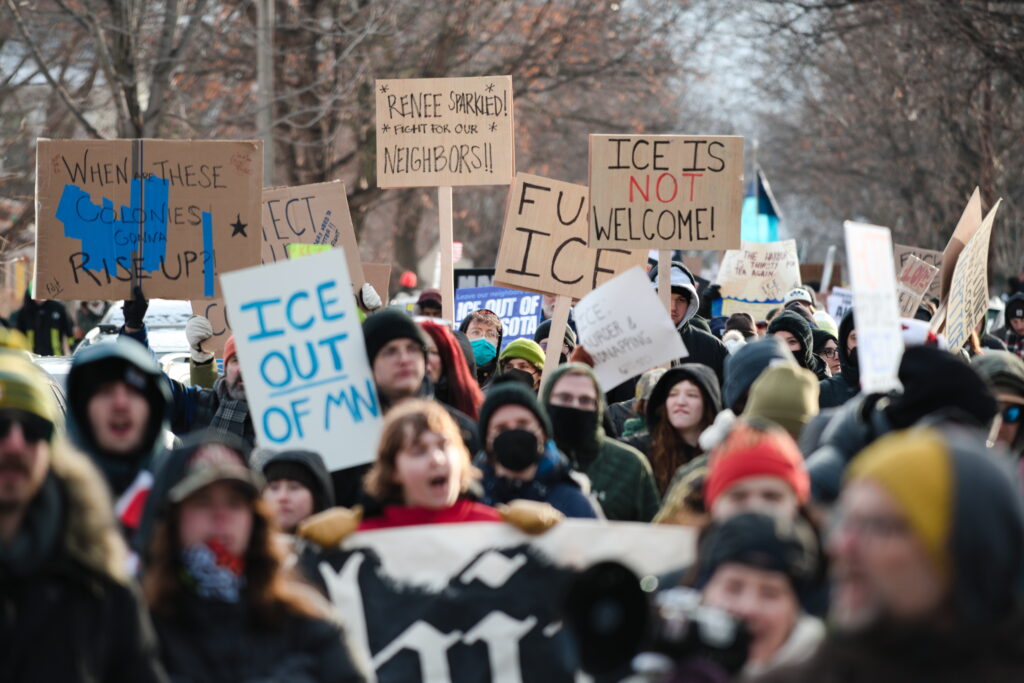
The first thing both made clear is this: what is happening with migration in the United States is not just a migration issue. It is one of the central fronts in the fight for democracy itself.
Migration as the Wedge: Why This Is Everyone’s Fight
Before we lose track of who is most impacted, let’s recenter. Around 50 million people who call the US home were born elsewhere, some have arrived recently, and others have been here for decades. Some came fleeing war or violence, while others came for work, love, or study. These are neighbors, students and grandparents, as well as workers holding down whole sectors of the economy from science to nursing to agriculture. The same is true in much of the world, whether it is acknowledged as part of the national narrative or not.
Fear-mongering about migrants and borders is not new, but it has proven to be the most effective wedge issue for authoritarian movements in many parts of the world of late. This is not an accident. What makes migrants such useful scapegoats is precisely their exclusion: people denied the vote and the basic protections afforded to citizens can be attacked at little political cost. This targeting also runs along colonial legacies, who counts as a ‘migrant’ versus an ‘expat’, and feeds racial and religious othering. Would the US American public have accepted a 20,000-member federalized police force to enact Trump’s political agenda against citizens? Hard to imagine. Against immigrants? Here we are.
As Avalos put it bluntly during the session, mass deportation is “a utility to deliver an authoritarian regime.” The same is true of anti-Muslim and anti-Somali narratives in Minnesota, of anti-Roma rhetoric in Europe, of scapegoating of asylum seekers and precarious migrant workers across the political landscape: these are tools of consolidation, not genuine policy responses. They create the conditions for cheap labor, distract from economic structures causing precarity, and test how far democratic norms can be eroded before people push back.
Shah, who has been organizing against immigration detention since the aftermath of 9/11, described watching the system expand from what was once a more targeted instrument into something far more sweeping. “The way that fascism operates is through law enforcement,” she said. It is worth noting that “enforcement” is one of the bureaucratic terms that both frame and sanitize the issue we are talking about. The word reinforces the dominant story that immigrants are a dangerous threat, presumptive criminals rather than neighbors with dignity who deserve protection. Immigration enforcement structures are designed to instill fear in wide swaths of the population, and the 20,000 ICE agents now deployed across the US are not simply an immigration agency. They are the advance infrastructure of a broader authoritarian project, one that is explicitly designed to intimidate not just migrants but anyone who dissents, evidenced using deadly force against immigrants and protesters alike.
This analysis should land hard for anyone watching their own government drift in a similar direction, sometimes with less organized resistance than the US immigrant justice movement has built. While tactics don’t map one-to-one across contexts, much of the underlying logic does. And for anyone working on democracy, on climate, on labor, on gender justice: if you are treating migration, or trans rights, for that matter, as someone else’s issue, you are misreading the terrain, and we all suffer the consequences.
Infrastructure Is the Fight
As of early 2026, roughly 70,000 people are held in immigration detention in the United States on any given day, not as punishment for any crime, but for their immigration status alone. Behind that number are parents taken from their children, essential workers seized from their jobs, neighbors who do not come home after attending an appointment to adjust or renew their immigration status. Over the course of fiscal year 2025, more than 310,000 people passed through the system, 91 percent of them in privately operated facilities. There have been at least 35 deaths in ICE custody under the current administration. The conditions are well documented and frequently horrifying; Shah pointed to the case of the Irwin County Detention Center in Georgia, where forced gynecological procedures, including hysterectomies, were performed on detained women. This is not an aberration at the margins of an otherwise functional system. It is the system, and at this scale, both in absolute numbers and in the speed of its recent expansion, it is historically unprecedented. Yet again, it is not only a US story: migrant detention is being expanded across Europe and around the world.
One of Shah’s central contributions to this conversation, and to the broader movement, is the insistence on understanding immigration enforcement as infrastructure, not just as policy. Most detention centers in the US were not built to be detention centers. They are former prisons, county jails, and repurposed industrial buildings. They exist because of contracts with local governments, because of zoning decisions, because of capital flows from private prison companies and financial institutions. Each of those is a pressure point, and each can be organized around. Of the roughly $170 billion allocated to immigration enforcement overall, some $45 billion is carved out specifically for detention, money that, once spent on physical infrastructure, becomes extraordinarily difficult to claw back, not least because the private corporations operating these facilities profit from keeping them full.
Detention Watch Network’s Communities Not Cages campaign, targeting the ICE and CBP budget, is built on this logic. According to Shah, eight US states have now passed laws restricting or prohibiting immigration detention, including Illinois and most recently New Mexico. These wins didn’t come from litigation. They came from years of painstaking work to make people understand the system, its financing, its dependencies, its vulnerabilities, and then organizing at the local, state, and federal levels simultaneously.
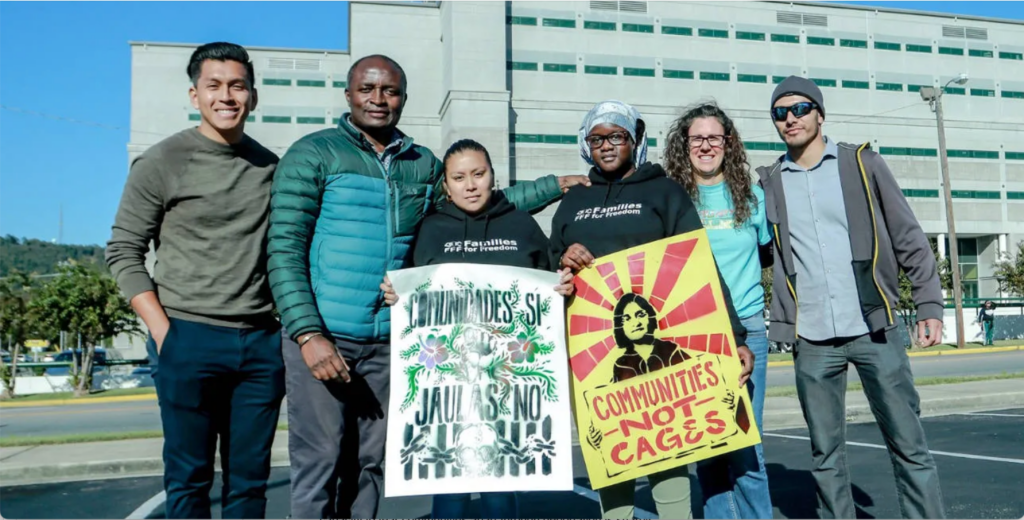
In Minnesota, the absence of large-scale detention infrastructure (due to past organizing) was a crucial factor in limiting the scale of the enforcement surge the Trump administration attempted earlier this year. When 3,000 ICE agents descended on Minneapolis, the combination of movement infrastructure on the streets and a lack of detention capacity to feed constrained what they could do. The lesson is blunt: where the capacity to detain at scale doesn’t exist, the capacity to tear communities apart through deportation is sharply limited. The time to fight anti-democratic infrastructure is before it exists.
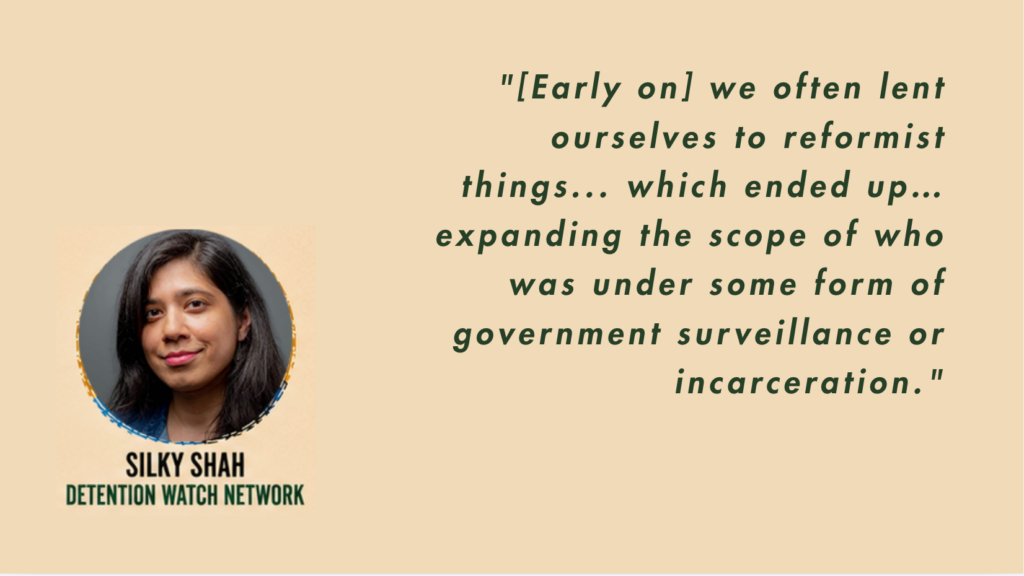
This has an important implication for how movements, and those who fund them, think about strategy. Shah was direct about a lesson Detention Watch Network learned the hard way: reform strategies that aim to improve conditions or create “alternatives to detention”, electronic ankle monitors being the classic example, can end up expanding the scope of government surveillance and control, bringing more people under some form of monitoring.
These sorts of strategic miscalculations also apply to narrative work across the movement more broadly. She reflected that the US immigrant rights movement “spent so many years on the narratives around good immigrants versus bad immigrants, old immigrants versus new immigrants…” that unintentionally undermined the conditions for wider solidarity and the fundamental right to dignity and belonging. Anti-immigrant actors were able to crack open these intra-community divisions leading up to the election, and “now we’ve gotten to this point where this administration is like: all immigrants are bad.”
This is a caution worth sitting with, for organizers designing campaigns, for funders deciding what to resource, and for narrative practitioners figuring out what stories to tell. While it is not easy to assess outcomes in advance, our work is to continue to question not only whether a strategy may win, but whether that win will entrench or transform the underlying system.
Big-Tent Organizing: Meeting People Where They Are
If Shah’s contribution was systems analysis, Avalos’ is something perhaps harder to teach: a relentless, grounded faith in the organizing potential of ordinary people, including people who don’t yet share your analysis.
Unidos MN is a statewide power-building organization in Minnesota that has, over years of base-building, created something powerful and rare: a membership that spans undocumented families, evangelical and Catholic parishes, meatpackers, construction and janitorial workers, and more.
What Avalos is describing is incredibly hard work, and it may be hardest for those of us with deeply held convictions, for whom not articulating our specific political commitments can feel like abandoning our communities or principles. But the alternative is to cede that ground entirely. As Avalos said: “if we don’t talk to each other, somebody else will.”
This is strategic intelligence. Unidos is not an ideological vanguard, Avalos was explicit about that, but it understands that the authoritarian project in the US, like so many projects of domination that have come before, has been deliberately designed to exploit the gaps between communities and obscure shared conditions. Anti-Somali narratives in Minnesota, anti-trans wedge politics nationally, economic resentment: these are coordinated tools. “All of us read the leaked memos [like Project 2025] and [read] the intention to polarize trans people, women, and immigrants in some type of utility to pursue and execute an authoritarian government.” The antidote is not to retreat into ideologically safe spaces. It is to build relationships across the divides that authoritarian actors are actively trying to deepen.
For Avalos, all of this is ultimately contested terrain. The authoritarian groundwork in Minnesota had been to fuse three narratives, mistrust of government, racial tension, and economic resentment, into a single story that scapegoated Somali and Muslim communities for the failures of a deliberately hollowed-out state. The work of the Unidos MN’s Monarca constitutional observer program isn’t only to document abuses; it is to crack that narrative, to put in plain view what was happening, and to model that solidarity, not scapegoating, is the real response to crisis.
“It is a battle of narrative and infrastructure versus narrative and infrastructure.”
— Emilia Gonzáles Avalos
What this looked like in practice, during the enforcement surge, was the Monarca Rapid Response line and constitutional observer program: a careful, emotionally intelligent on-ramp that helped ordinary people, many of whom had never been politically active, understand the stakes, rehearse the scenarios, and make their own choices about how to show up. Not “do this or don’t do that” (Avalos had a pointed critique of the risk-aversion of lawyer-led observer models), but: here is what you might face, here are potential consequences, here are the values at stake — how can you prepare for what you want to do when things are escalated?
What followed was thousands of people making that choice. And critically, it was not only the people most targeted and at risk who acted. The Monarca model was built on the insight that cross-status solidarity is both ethically necessary and strategically essential, that those with more legal protection need to take higher-risk roles. The movement is stronger when it distributes risk rather than concentrating it on the most vulnerable.

Participation Is Not One-Size-Fits-All
One of the most insightful exchanges of the session came in response to a question from Miman Jasharovski, a German Roma activist and With Wings and Roots board member, who described the difficulty of getting people directly affected by immigration enforcement and racism to participate visibly in street protests, and the frustration of seeing mostly white allies at demonstrations.
Avalos’ response offered an alternative frame. The nervous system, she said, “works in a very individualized condition.” Communities at risk cannot always be the ones on the streets and expecting them to be sets them up to fail and sets the movement up to misunderstand what solidarity requires. Instead:
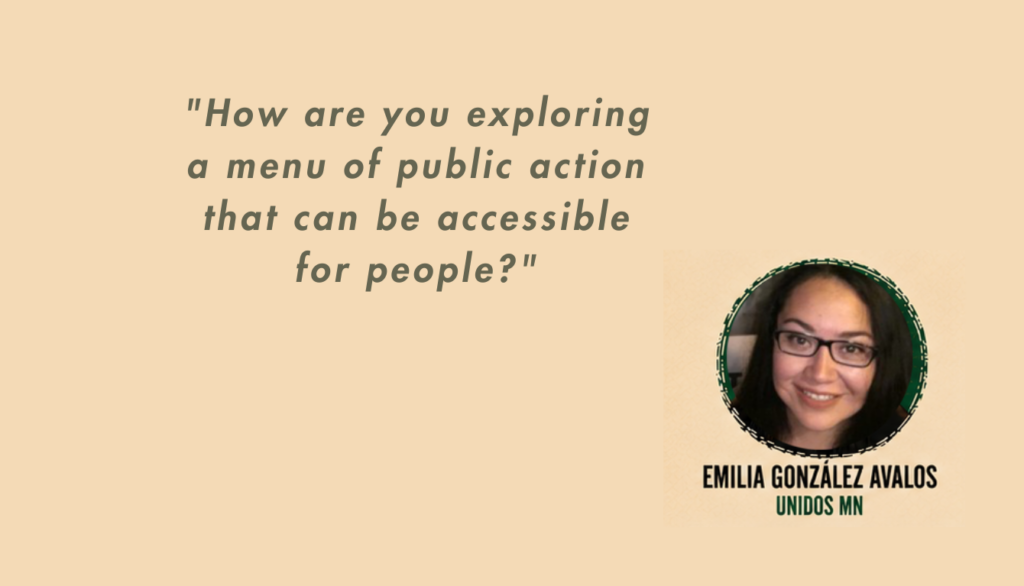
House meetings. Know-your-rights trainings. Training other trainers. Documentation. Bearing witness. These are not lesser forms of action, they are essential, and in many contexts, the more sustainable ones. While protest is indeed an essential metric of movement strength, focusing on that may prevent us from noticing the many powerful acts of leadership, political education, mutual aid, cultural expression, community building, and advocacy that create the layered, distributed infrastructure our movements need.
Shah made a complementary point: one of the strategic imperatives is ensuring that when political openings emerge, the movement is ready to move. She invoked US Civil Rights activist Ella Baker’s concept of “spade work“: the patient, less visible preparation of the soil for change that makes it possible to seize those moments. Shah’s example was during 2020–2021 they were able to achieve a period of rapid detention center closures after years of doing exactly that, building the infrastructure, the narrative, the coalitions, so that when the murder of George Floyd opened a wider conversation about racial justice and abolition, the movement knew what to ask for.
A Note on What This Asks of Philanthropy
For the funders and philanthropic partners reading this, this session is an invitation as much as an inspiration.
Across the sector, funders are quietly pulling back from migration, treating it as too polarizing, too intractable, too politically exposed. This is exactly the wrong move at exactly the wrong moment. It cedes the most contested terrain in our politics to those who have invested most heavily in dominating it, precisely because retreat is the path of least controversy. The lesson of this moment is not that migration funding should shrink, but that it should grow to include a longer horizon, and that it should reach across sectors. If migration is the wedge being used to fracture democracy, then democracy, climate, labor, education, arts and gender-justice funders all have an enormous stake in contesting it. We may well need radically new approaches. What we do not need is less.
Shah’s warning about reform strategies that expand surveillance is also a direct challenge to how much of philanthropy operates: funding the legible and the measurable without asking whether a “win” shrinks the system or quietly grows it. The long-horizon work that most portfolios underfund, the Detention Watch Network’s 30-year investment in understanding the political economy of incarceration, is what produced the capacity to move decisively when the moment arrived.
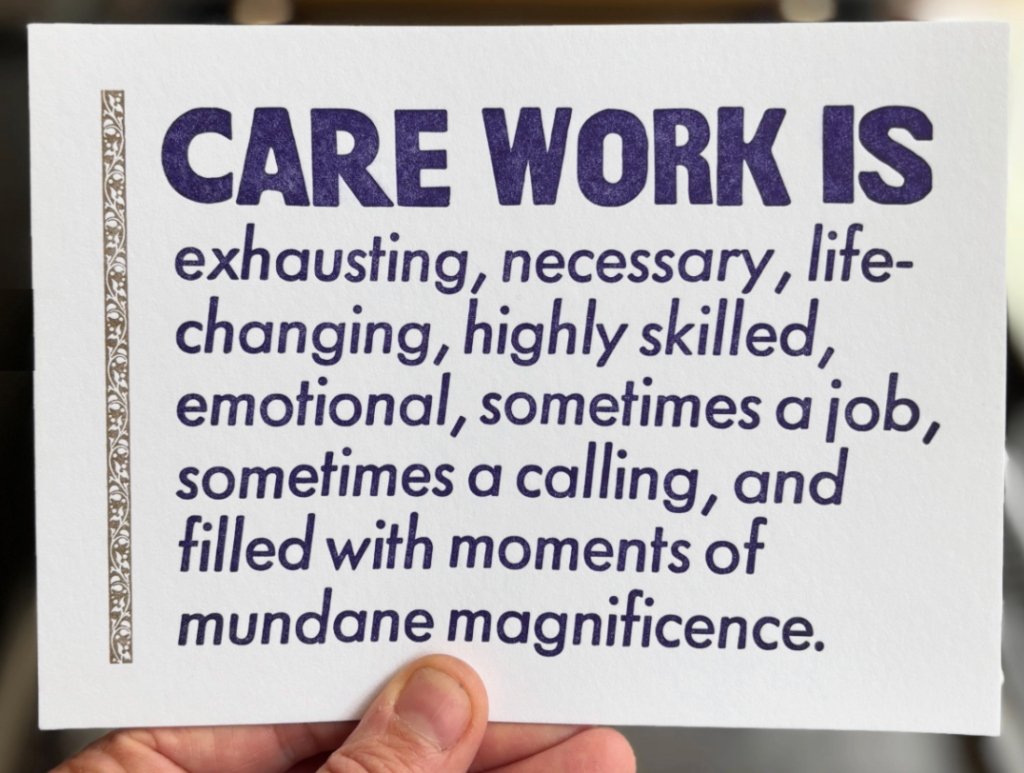
Emilia’s model of big-tent, grassroots organizing, time intensive, relational, slow, and genuinely cross-ideological, is also the kind of work that philanthropy struggles to fund. It is hard to evaluate on a two-year grant cycle and impossible to attribute to a single outcome. But it is what is required to block authoritarianism and create pluralist democracies rooted in belonging.
Cross-Border Learning as a Practice
One of the explicit purposes of Belonging Beyond Borders is to create the kind of transnational learning exchange that this webinar offered, bringing the hard-won lessons of organizers to movements around the world facing analogous pressures, while also recognizing that what works in Minneapolis does not automatically transfer to Berlin or Johannesburg or Nicosia. Many of the structural conditions that enable this type of organizing in the US are entirely different elsewhere, and therefore, much adaptation is needed.
What does transfer is the underlying analysis: that migration is being weaponized as a tool of authoritarian consolidation everywhere it is politically useful to do so; that the systems enabling this are built on infrastructure that can be contested; that movements capable of meeting people where they are, and building on-ramps at a hyperlocal level rather than demanding ideological purity, are the ones that are growing the base; and that the communities most directly targeted cannot be left to carry this fight alone, not only because they absolutely deserve our solidarity, but because our fates are fundamentally entangled.
Here is the recording of this session. Our Democratic Resilience memo that informed it, an ecosystem map of anti-enforcement organizing in the US — is available for download and is intended as a resource for organizers globally.
If this conversation speaks to work you are doing, we would love to hear from you. And if you are not yet finding ways to frame a dignified approach to migration as central to democracy, please consider this a warm but urgent invitation to join us. We have much to learn from one another, and are happy to be in conversation about how.
— — —
About the author and moderator
Christina Antonakos-Wallace is a filmmaker and lifelong activist, initiator of the Belonging Beyond Borders network, Global Lead of With Wings and Roots, and on the Core Team of Building Belonging. She works between the US and other geographies, connecting organizers, researchers, artists, and policymakers working for migrant and social justice across continents.
About the speakers
Emilia Gonzáles Avalos is Executive Director of Unidos MN, a statewide multi-racial power-building organization in Minnesota. An immigrant from Mexico City, she has spent her career organizing low-wage workers, migrants, and communities toward social and economic justice.
Silky Shah is Executive Director of the Detention Watch Network, a national coalition organizing to abolish immigration detention in the United States. She has worked on racial and migrant justice for over two decades and is the author of Unbuild Walls: Why Immigrant Justice Needs Abolition (Haymarket Books).
Citations
What’s in the Big Beautiful Bill? Immigration and Border Security Unpacked
20,000 ICE Agents: ICE Government Website
Senate Committee Finds Medical Abuse of Detained Women at Georgia ICE Facility
Detention statistics, Detention Watch Network (figures as of early 2026 / FY2025)
Communities Not Cages campaign, Detention Watch Network
Community Defense and Democratic Resilience memo
Unbuild Walls: Why Immigrant Justice Needs Abolition Silky Shah (Haymarket Books)