Cracking the Piggy Banks of the Bunker Class and the Void No Fortune Can Fill
The promise of modern capitalism is simple: accumulate enough wealth, and you will buy your freedom. Financial independence is marketed as the ultimate antidote to anxiety, the door to a life of peace, autonomy, and self-actualisation. Yet, inside the hushed offices of financial therapists and the raw testimonies of Miho Soon’s ‘Money Trauma’ podcast, a more disquieting story is being told. There, wealth is not a portal to serenity but a gilded cage. It turns out that for those who carry unhealed financial trauma, accumulating more zeros in a bank account does not quell the survival brain; it feeds it. The relationship between psychological security and net worth is not linear, it’s a trap.

To understand why the rich so often continue to hoard with a desperation indistinguishable from poverty, we must abandon the notion that money is mathematical. We must follow the trauma into the body, trace inherited fear through the bloodstream, and interrogate a system that profits from our permanent dysregulation, while also seeking the keys that might unlock the cage. When Elon Musk blasted past $800billion and immediately declared “$10 trillion or bust” on X, he was delivering the textbook symptom of financial trauma. The void cannot be filled, because the void is not financial.

The Body Keeps the Financial Score
The first radical reframing offered by the ‘Money Trauma’ podcast is that our financial lives are not driven by logic, but by the autonomic nervous system. When Miho Soon posits that 90% of financial decisions are emotional, she is not speaking in metaphor. Peer-reviewed research on financial socialization confirms that our earliest money memories, a parent’s silent panic over a bill, the shame of a food bank queue, the electricity being cut off, encode themselves into the limbic system. The brain does not distinguish between a physical threat and the existential threat of financial ruin. For a child, a caregiver’s distress about money signals a potential collapse of the nest, triggering the same sympathetic nervous system activation as a predator at the cave mouth.

Psychologists have labeled this “financial trauma,” the physical and psychological response to chronic financial stress that embeds itself in the body. As adults, when we sit down to budget or check our portfolio, the prefrontal cortex, the seat of executive function, is not running the show. If the nervous system has been primed by scarcity, the very act of looking at a spreadsheet can trigger a dorsal vagal shutdown, commonly mislabeled as “laziness.” The person does not rationally choose to avoid their finances; they are neurologically flooded. This is the “affective dissonance” Rachel Sherman (2017) diagnoses in her study of wealthy New Yorkers who, despite their objective resources, are haunted by a nagging, socially mandated need to justify their privilege, a discomfort they manage through downplaying and moral credentialing rather than structural divestment.
Miho’s podcast demolishes the myth of the rational economic actor by showing that for millions, a depleted bank account does not produce a prudent calculation instead, it produces a flashback.

Hoarding as a Failure of Safety
If trauma explains the paralysis of the poor, what explains the pathology of the rich? This is where the podcast’s inquiry into wealth accumulation becomes intellectually scintillating. In the episode on the psychology of the wealthy, Soon dismantles the assumption that crossing a certain threshold dissolves fear. Instead, she suggests, wealth often calcifies the trauma, giving the survivor unlimited resources to build a fortress against a danger that has already passed.
Here, the clinical literature offers a devastating parallel: the behavioral cycle of hoarding disorder. True hoarding is not about the objects; it is about the intolerable distress of discarding them. The clutter is a physical buffer against an unpredictable world. Financial wealth hoarding functions identically. The titular trauma creates a void of felt safety. The survivor learns that money equates to survival and begins to accumulate. But because the void is internal, a disregulated nervous system, an epigenetic echo of ancestral starvation, the safety never arrives. The anxiety simply shifts its target. One need only look at Peter Thiel’s publicised pursuit of apocalypse-proof New Zealand bunkers and parabiosis blood-infusion therapies. This is not rational futurism; it is a man drowning in capital, yet still gasping for the physiological security his limbic system is structurally unable to generate.
This is the cruelest distortion of worldview. A person who has experienced financial trauma, even if they later become fabulously wealthy, often perceives the world as perpetually scarce. Their reality becomes a zero-sum game. Empathy, which requires a relaxed, socially engaged nervous system, becomes biologically unavailable. Instead, they see competitors and threats. The system rewards this pathology with more capital because the hypervigilant hoarder makes for an excellent capitalist, driven, relentless, and incapable of saying “enough.” The podcast boldly suggests this describes many titans of industry, unpacking how their childhoods of emotional or material deprivation birthed empires that consume instead of heal.

The Counter-Narrative: Iris Brilliant and the Courage to Dismantle the Fortress
If the trauma-driven hoarder represents the cage at its most fortified, the work of Iris Brilliant offers a blueprint for dismantling it from the inside. Brilliant, a coach and organizer who came into an unexpected inheritance at 22, experienced firsthand how wealth can hinder “our capacity for intimacy, honesty, and vulnerability”. As someone already active in anti-racist and feminist movements, she found herself unable to reconcile her values with owning stocks in guns, oil, and tobacco. This crisis of integrity became her life’s mission: supporting people with wealth to move money toward social justice.
Brilliant’s approach is not about guilt-driven giving. It is, fundamentally, a reclamation of the self from the isolating architecture of capital. Her work centres on disentangling “self-worth from net-worth” and working through the “shame, scarcity, and reactivity” that keep wealthy individuals locked in a fortress of hypervigilance. Where the hoarder, as described above, accumulates endlessly to fill a void of felt safety, Brilliant guides people to find genuine safety through reconnection: to their values, to community, and to a sense of “belonging to something bigger than ourselves”. Her paradigm-shifting work posits that the exit from the gilded cage demands not only personal neurobiological healing but a courageous, bodily re-entry into the collective, a deliberate plunge into the interdependent vulnerability that the money taboo (Trachtman, 1999) and the shame-cycle are designed to prevent. As Shapiro (2007) notes in the context of couples therapy, the mere act of transparently discussing money can be a therapeutic tool that unravels deep-seated power dynamics. Brilliant scales this to the political: if the system sickens us by keeping the traumatized wealthy isolated, then the conscious, deliberate act of moving wealth into community, of funding reparative justice, of shattering the familial omertà of money silence, is a profound act of guerrilla ontology.
This mirrors Miho Soon’s critique of who benefits from financial isolation while illuminating a path forward. If the system profits from keeping the traumatized wealthy person isolated and hoarding, then the act of moving wealth into community, of funding social justice, of breaking the taboo of money silence in families, is a form of sabotage against that system. Brilliant’s methodology, which asks people to “align wealth with our personal values” to “create a framework of collective liberation,” is the practical application of the trauma-informed diagnosis that podcasts like Money Trauma provide.

The Bloodstream of Generations
This worldview distortion is not just personal; it is inherited. Miho Soon’s personal testimony, woven through the series, describes the “survivalist” mindset passed down in a family that broke the chain of poverty in Malaysia. Despite material success, the emotional posture of scarcity persisted. The check was always about to bounce. The rug was always about to be pulled. Classic case of intergenerational transmission.
The science of epigenetics lends a haunting biological weight to her story. The Dutch Hunger Winter studies, research on the descendants of Holocaust survivors, and studies of communities that endured mass financial shock reveal that severe stress chemically alters gene expression. A grandparent’s hunger is not just a story; it can alter the cortisol regulation of a grandchild who has never known a day of food insecurity. In families of class migrants, this creates a unique psychological torment. The “new money” individual has the exterior markers of success but an interior still coded with the vigilance of the peasant. Migrating into a higher class, as Soon notes, holds up a mirror to the shame narratives internalised about one’s origin, creating a painful double-consciousness: too wealthy for the old neighbourhood, too “rough” for the new one. Here, Brilliant’s work on “inner resilience and adaptability” becomes crucial: not to erase that origin story, but to metabolise it.
The System That Profits from Your Pain
Finally, the Money Trauma podcast connects the personal to the political with a question as old as Marx but refracted through a trauma-informed lens: who benefits when you believe your poverty is a moral failing? Mainstream “financial literacy” fixes blame on the individual, prescribing tighter budgets as if the problem were arithmetic rather than a nervous system locked in a freeze response. This narrative is a feature of the system, not a bug. A population that self-blames does not unionize; a traumatized worker is easier to exploit. Soon’s critique, echoing the work of financial therapists like the Klontzes (2009) who reframe so-called “money disorders” as survival adaptations, maladaptive, attempts at self-regulation, is a profoundly political act of reclamation. The person prone to “overspending” may be seeking the dopamine of safety in a cold world; the workaholic may be fleeing the silence where old wounds live.
Yet the true exit from the gilded cage is not a bigger budget, nor is it simply giving all the money away in a panic. It is the slow, painful work of healing the nervous system itself, learning to feel safe in the body so that money can return to its rightful place as a tool, not a life raft. But healing, here, cannot be a private, interior affair. The nervous system does not regulate in isolation; it co-regulates, or it does not regulate at all. This is why the work must also be collective, political, and practiced. The money-traumatized cannot think their way out of the fortress; they must do their way out, through the embodied praxis of redistribution, not as charity, but as a deliberate, repeated, somatic relearning of safety through solidarity.
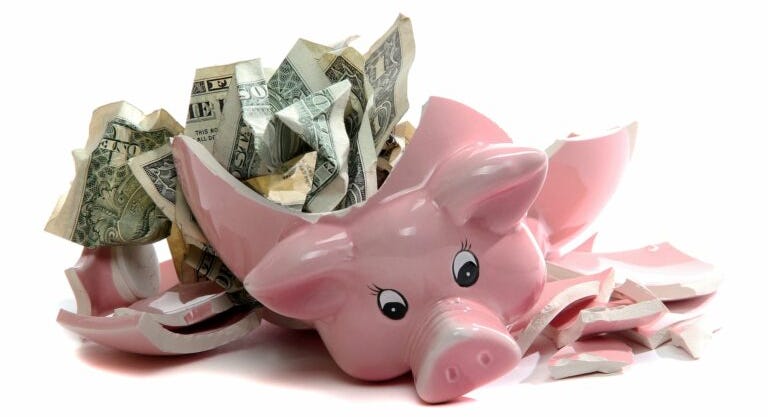
This is the terrain organisations like the Guerrilla Foundation, the Dalan Fund, Weaving Liberation, Black Feminist Fund and Collective Abundance are cultivating: spaces where wealthy individuals are invited not merely to write cheques, but to become politicised participants in movements, to sit in rooms where they are not the most powerful, to surrender control, to build relationships across difference, to let their money move at the speed of trust (and political upheaval), and to fundraise among their peers & activate the wealth class. The act of redistribution, done in accountable community, becomes a form of exposure therapy for the hoarding nervous system, a slow, deliberate practice of cracking the piggy bank open, again and again, until the terror subsides and something resembling genuine safety, the kind that cannot be purchased, begins to take root. It is also the courageous act, as Iris Brilliant models, of looking at one’s portfolio and one’s privilege not with the paralysis of shame, but with a fierce resolve to reconnect. The ultimate luxury for the money-traumatised is not passive income, but the hard-won capacity to sit in stillness without the impulse to hoard, spend, or flee, and to extend that regulated stillness outward into authentic, generative belonging, a belonging that is not bought, but built, in the risky, unglamorous, and profoundly liberatory practice of collective struggle.