How a coalition of American grantmakers decided to stop funding the status quo and start funding the barricades and why Europe is still stuck writing polite grant applications while Rome burns.
The Block and Build Funder Coalition as a Blueprint for Philanthropic Spine.
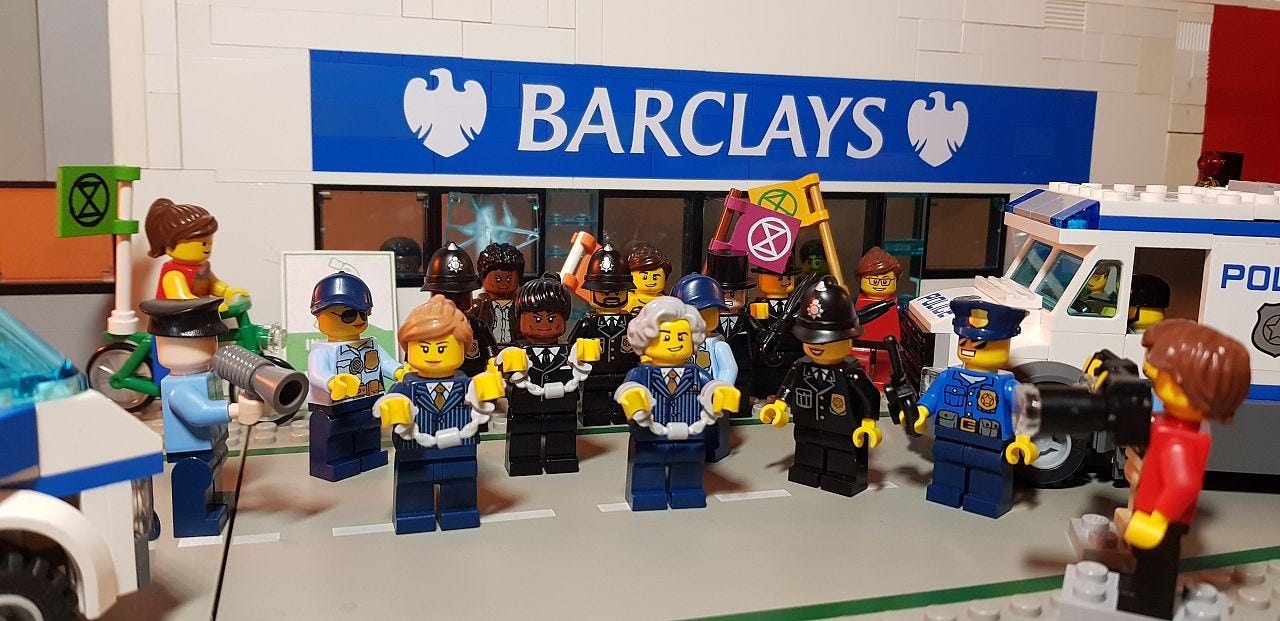
There is something almost childlike in the directness of the name “Block and Build”, the grammar of a Lego instruction manual applied to the defence of democracy. But the name is not the issue. The issue is that it took until 2024 for a coalition of American grantmakers to state the obvious: that philanthropy, if it wishes to remain relevant, must stop behaving like a polite bystander at its own funeral. While European foundations continue to fund another round of “democratic resilience” workshops as if authoritarianism were a deficit of moderation rather than a well-financed assault, the BBFC has done something genuinely uncomfortable: it has named the adversary and organised accordingly. Born not of electoral panic but of strategic anticipation, the coalition represents the most clear-eyed re-founding of progressive philanthropy in decades, a recognition that money, like water, seeks the path of least resistance, and that the path of least resistance right now cuts directly toward authoritarian capture. The name is blunt because the moment has no use for euphemisms.

The Architecture of Defiance
Born in the crucible of 2024 from the strategic foresight of Women Donors Network and Solidaire, the BBFC was not a panic response to an electoral defeat but an anticipatory strike against what its architects diagnosed as an emergent authoritarian playbook.2.4 When congressional committees began targeting pro-Palestinian organisations with requests for Treasury Department information, Leena Barakat, WDN’s president, recognised what many dismissed as a one-off attack for what it was: a test. “My gut told me this was a test,” she later reflected, “and whatever happened here would eventually make its way to other organizations, other movements, and it would grow“.4
This is the art of philanthropic jiu-jitsu, and it rests on a simple, uncomfortable premise: the legal and financial infrastructure designed to safeguard civil society can be weaponised against it. The “nonprofit killer bill”, HR 9495, threatened to grant the executive branch the power to strip tax-exempt status from any organisation designated as “terrorist-supporting,” a designation requiring neither conviction nor due process. In that atmosphere, the BBFC’s insistence that funders not “distance themselves or stop funding grantees who may have been targeted” constituted a radical act of solidarity.4
By early 2026, the coalition had swelled to 475 participants representing over 200 organisations with a collective funding capacity exceeding $6 billion annually. That figure, vast as it is, is not the whole story. The key story is the structure: monthly strategy calls, resource libraries, media training, scenario-planning exercises, and a deliberate heterogeneity of membership spanning public and private foundations, corporate funders, and movement organisations that inform strategy without diluting their frontline credibility. This is a move away from the tired, old, donor circle with good intentions and instead the establishment of a distributed intelligence network with a strong grantmaking budget.4

The Uncomfortable Mirror Across the Atlantic
If this all sounds terribly American, that is because the threat currently most visibly and dramatically manifests on American soil. But to mistake American authoritarianism for an exclusively American phenomenon is to commit the cardinal analytical sin of parochialism and short-sightedness. The data from Europe is the stuff of night sweats. A cross-border investigation into political financing across 24 European countries revealed that between 2019 and 2022, a full quarter of all private donations, €150 million, flowed to populist, far-right, and far-left parties. Far-right groupings alone vacuumed up more than €97 million, or one in every seven euros donated.5 In countries such as Slovenia, Italy, Poland, Hungary, Portugal, and Greece, extremist and populist parties now absorb more than half of all non-public political funding.5

The mechanisms by which this money moves are intricate and often brazenly opaque.
Consider the Desiderius Erasmus Foundation, the intellectual arm of Germany’s AfD, a party officially classified by the Federal Office for the Protection of the Constitution as a “confirmed right-wing extremist endeavor.” Despite this designation, the AfD and its parliamentary apparatus stand to receive more than €120 million in annual state funding, a figure derived from the perverse cocktail of public party financing, MP salaries, expense allowances, and staff budgets.2 Structural analysis suggests that the actual figure may be significantly higher, given the exclusion of parliamentary committee compensation, pension contributions, and rising membership dues that trigger additional state matching funds.2
Across the Channel, British institutions have become conduits for Hungarian soft power with a hydrocarbon aftertaste. An investigation revealed that the Roger Scruton Legacy Foundation received over £512,500, more than 90% of its funding, from Mathias Corvinus Collegium, a Hungarian academy endowed with state assets including a stake in the energy giant MOL Group, which refines oil predominantly sourced from Russia.6 Through this pipeline, far-right and anti-trans voices have secured wider platforms in the architecture of the British establishment have been quietly redecorated in the ideological furnishings of Viktor Orbán’s illiberal democracy.
Meanwhile, the Atlas Network, funded by Koch-linked fortunes and corporate interests in fossil fuels, tobacco, and pharmaceuticals, maintains 589 partner organizations across 103 countries, deploying a sophisticated influence strategy that cloaks ideological warfare in the language of dispassionate expertise.8 Its European partners, including ECIPE and Epicenter, have successfully insinuated themselves into EU policymaking, shaping trade agreements and regulatory frameworks while cultivating relationships with liberal as well as conservative factions.8 The network’s modus operandi is instructive: it does not merely fund political campaigns; it funds the infrastructure of ideas, the think tanks and academic programs that shift the Overton window long before any ballot is cast.

The Missing European Analogue
Against this backdrop, the absence of a European analogue to the Block and Build Funder Coalition is not merely conspicuous; it is perilous. European philanthropy, particularly in its progressive expressions, remains fragmented, nationally bounded, and philosophically conflicted about its own power. The continent possesses immense wealth, the aggregate assets of European foundations run into the hundreds of billions, but that wealth is too often deployed with a fastidiousness that borders on paralysis, disbursed in cautious grants to uncontroversial projects while the machinery of authoritarian populism is being financed with the swagger of ideological certainty.
An effective European coalition would need to embody the same dual strategy, blocking and building, but adapted to a multijurisdictional reality where the threats are both transnational and nationally specific. Blocking, in this context, would involve coordinated legal strategies, intelligence sharing on dark money flows, and rapid-response funding mechanisms for organisations facing political or legal assault. Building would mean investing in cross-border media infrastructure, pro-democracy civil society organisations, and the unglamorous, long-term work of narrative cultivation.
Potential Vanguard Funders
If a European Block and Build coalition is to materialise, it will not be led by the cautious legacy foundations that have spent decades mistaking politeness for principle. It will be built by funders who have already accepted that philanthropy is inside politics, not above it. Several such institutions already exist, operating with the clarity of purpose that makes the rest of European philanthropy look like it is still rehearsing for a role it lacks the nerve to perform.
Mama Cash, the oldest international women’s fund, has long financed feminist movements that challenge state violence, border regimes, and extractive economies, making it one of the few established funders with both resources and political nerve. The Dalan Fund operates across Central and Eastern Europe, the Caucasus, and Central and Northern Asia, where its Shield Fund provides rapid-response crisis grants to movements confronting “foreign agent” laws and anti-LGBTQ+ statutes, placing decision-making power in the hands of movement actors rather than donor boards. Weaving Liberation, hosted within the Digital Freedom Fund, has publicly condemned funders who “depoliticise narratives, police language, and condition funding in ways that silence truth-telling and fracture solidarity,” and through #Funders4Palestine has advanced a sharp critique of philanthropic complicity while calling for material solidarity with Gaza. The Safe Passage Fund, governed by an all-women activist council with lived experience of migration and displacement, funds unregistered collectives and informal structures across Southern, Central, and Eastern Europe, explicitly framing its work as “a political instrument against the structural, deadly violence of the European migration regime.” Alongside them sit the Black Feminist Fund and the operational solidarity networks, Watch the Med, Alarm Phone, Blindspots, civilfleet-support, that rotate through the governance, creating a distributed infrastructure of resistance. Guerrilla Foundation, based in Berlin, but with a funding focus in Southern & Eastern Europe, explicitly backs activist movements and systemic change initiatives, organising people with wealth, and redistributing resources directly into grassroots organising rather than the usual suspects of the Charity-Industrial Complex.
The challenge for these funders is not summoning political will; they have demonstrated that in abundance. It is whether they can scale their influence without compromising the movement accountability that makes them distinctive. That is a real tension, but it is the right tension, the tension of organisations trying to build power responsibly, rather than the tension of legacy foundations trying to avoid controversy entirely. The comfort, for those who prefer their philanthropy quiet, has always been that these funders are too small, too explicitly political, too unwilling to speak the anodyne language of “democratic resilience” to anchor a continental coalition. The harder truth is that they are the only ones who have been taking the threat seriously all along.
“Authoritarianism is not normal, and it’s not acceptable,” Barakat has said of the BBFC’s posture. “We are here to not just fight against it, but to build toward new, better systems for everyone“. The absence of that bluntness in mainstream European philanthropic discourse is a major liability.

A Model Worth the Imitation Game
The BBFC model is worth replicating not because it’s perfect but because it is clear, adaptable, and strategically coherent. It offers a template for collective action that neither subsumes individual grantmaking autonomy nor permits the fragmentation that authoritarian movements exploit. It insists, as Ebrahimi articulated, that “we don’t want to just defend the status quo“, that the goal is to “transform our sector“ and “improve all the contradictions and complications and problematic qualities that exist within the philanthropic sector“. That ambition, to wield wealth in service of both critique and construction, to be at once defensive and utopian, is precisely the ambition European philanthropy has lacked at the moments when it has been most needed.
The comfort, for those who prefer their philanthropy quiet and their politics deniable, is that the far right’s funding advantage can be attributed to external factors: opaque donation laws, populist charisma, Russian oil money. The harder truth is that there has been nothing progressive about ‘progressive wealth’ and it has not yet organised itself with the strategic rigor, honesty and philosophical seriousness that the moment demands. The BBFC, for all its American particularities, has offered a proof of concept: a) funders can coordinate without centralising, b) can take political stances without losing charitable status, and c) can prepare for legal assault without retreating from their missions. The question that hangs over Europe is not whether the model is applicable but whether the continent’s philanthropic leadership possesses the nerve to apply it. The money exists. The threats are documented. The framework is available. What remains, as ever, in the tragicomedy of political will, is the decision.

References
1. Matthews RA. Block & Build: A framework for housing justice and philanthropy. Funders Together for Housing Justice. Published October 30, 2025.
2. Non Profit Quarterly, Faster Than Authoritarianism: Rapid Response as a Frontline Strategy for Democracy Defense, Santana Moreno. April 21, 2026
3. Good Law Project. Rightwing think-tank backing ‘sovereign’ nations fuelled by offshore funds. Published August 17, 2025.
4. Inside Philanthropy. The Block and Build Funder Coalition is pushing back on authoritarianism. Published March 10, 2026.
5. Follow the Money. Quarter of political donations in Europe are going to extremist and populist parties, data reveals. Published May 29, 2024.
6. Good Law Project. Putin’s megaphone: Orbán’s far-right push into UK universities is fuelled by Russian oil. Published February 11, 2026.
7. InfluenceWatch. Block and Build Funder Coalition. Published July 13, 2025.
8. Observatoire des multinationales. The Atlas Network, France & the EU. May 29’ 2024.