Much of our annual reports look outward, at grantees, movements, and the wider ecosystem of resource redistribution. Yet, its purpose is not just a critical examination of the worlds we are a part of, but a narration and reflection of our own journey vis-à-vis those worlds: how we position ourselves within the movement-backing sector, how we want to affect it, and crucially, how we live it internally. Because the political claims we make about power, participation, and transformation are either practised in our own structures or they are merely decorative.
This article offers a glimpse into a year inside Guerrilla: a candid reflection on the processes that decentralise decisions as we redistribute resources, a deep dive into the team and governance setup that makes this work happen, and a snapshot of how political reasoning informs the way we split incoming donations.
We do this because business-as-usual philanthropy needs hospicing. For that to happen, the unorthodox, radical redistributors need to collectivise their learnings, openly discuss their ways of working not for public aggrandisement but to spark conversations that can elicit restructuring towards values and practice alignment. Read on to learn about our 2025 insights, and reach out if you want to share experiences or feedback: romy@guerrillafoundation.org.
- Governance Evaluation
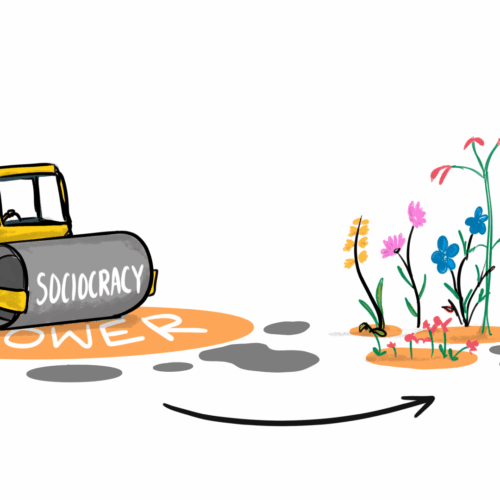
After eighteen months of participatory governance, in summer 2025 we subjected ourselves to a first systematic reckoning: an all-governance survey spanning Activist Council, Funders Circle, and team. We asked about decentralised decision-making, information flow, mutual accountability. A follow-up session dug deeper into the feedback. What emerged was less a verdict than a map of where the work now lies. Structures exist; living them is harder. We have built the architecture, circles, roles, decision-making protocols. Now we need to inhabit it. That means ensuring all circles actually follow the guidelines we set, that decision-making domains are unambiguous, that people understand what it means to hold a role, and that we pause to examine where projects stall, not to assign blame, but to extract learning. The broader project here is simple and infinite: knowing who we resource, and whether we’re actually backing self-led movements or just funding other people’s ideas of what those movements should look like.
Onboarding is a structural obligation, not a courtesy. At any given moment, someone new is joining our AC, FC, or team. This demands a proper information base: a living Wiki, documented processes, an onboarding buddy, a sequence of one-to-one and group meetings through the first three months. All of it grounded in communication tools that are genuinely accessible. Onboarding is where participatory governance either becomes real or reveals itself as theatre.
Mutual accountability is collective before it is individual. Task-level responsibility matters, but it is not the point. The point is arriving at a place where team, AC, and FC hold collective ownership of this organisation, while remaining clear-eyed about the different starting points, time, commitment, proximity, from which people move into that ownership. Stepping back from centralised power must not produce a vacuum. This conversation is ongoing because the risk is structural, not transitional.
Trust takes time, and time takes intention. We are trying to bridge divides of wealth, class, geography, political orientation, generation. That requires space to hear each other before we can hope to move together. The necessary emphasis on process and structure during governance transition, compounded by the flatness of virtual collaboration, creates real hurdles to human connection. Shared purpose is not self-generating. It requires tending.
Political sensemaking is not a luxury. Connected to the above, we need deliberate space to make collective sense of the political conditions we are living through, the developments, the lenses, the ideological differences that shape our thinking, and how these relate to Guerrilla’s purpose and activity. Without this, governance becomes technocratic; with it, governance becomes political in the only way that matters.
- Benefactors to Accomplices: reshaping funder participation
Our thinking on transforming philanthropy turns on a single axis: the relationship between those who hold wealth and those who do not. The dominant model is one-way dependence, with accountability flowing upward to the funder. We replace this with something less comfortable for all parties: a trust-based relationship grounded in mutuality, where every contribution to systems transformation, money, knowledge, labour, networks, is recognised as such.
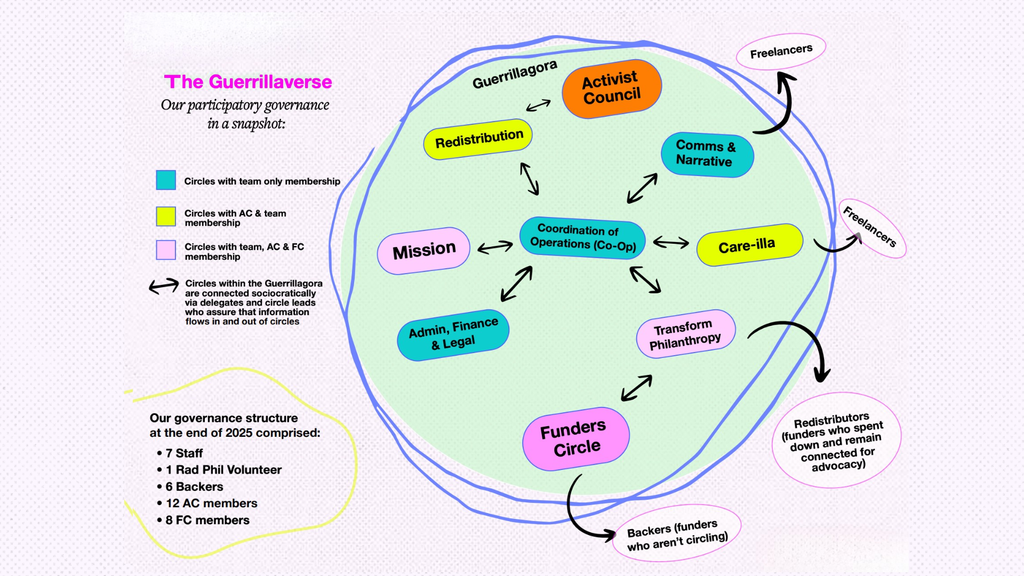
This is why funders participate directly in our governance. Not in grantmaking decisions, those remain the domain of the Activist Council (primarily) and staff, but in strategic and intra-organisational matters. Funders Circle members are not outsiders resourcing work done by others. They are, in the language we use deliberately, accomplices. The most acute expression of this is the Radical Philanthropy Volunteer role, but the principle runs through the whole: FC members self-organise as a group, are consulted on strategy, and can sit in our Mission Circle, Transform Philanthropy Circle, and temporary working groups.
This kind of participation cannot be reduced to filling a pre-defined slot with a time commitment attached. What we ask, and what we try to support, is something more demanding: that funders stay current with what is happening in the organisation, engage in self-reflection about where they can and want to contribute, and build a meaningful connection to the project that goes beyond the cheque. The challenge is not administrative. It is existential. It requires a mindset shift, for funders, but also for us, toward a form of involvement that is unusual in philanthropy precisely because it refuses to let money substitute for presence.
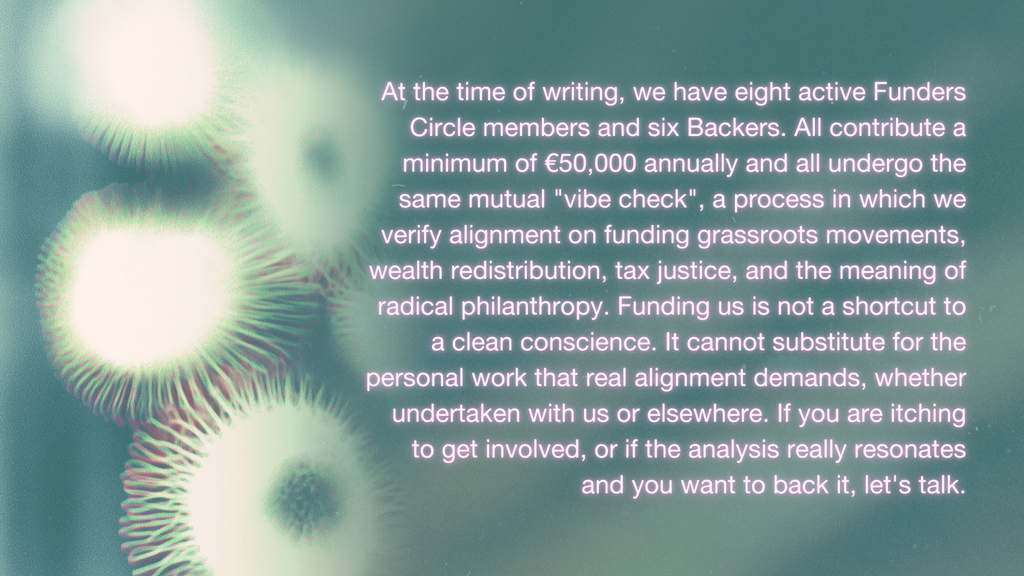
The relational density this demands works best at a small scale. We currently aim for eight to ten committed individuals who are willing to make that personal investment to the FC. In mid-2025 we added a structural complement: the Guerrilla Backers, a container for funders who are no less committed but chose to be less involved in day-to-day governance. We envision fluid movement between these structures, funders self-organising according to where they are on their journey, in their lives, and in their capacity to contribute at a given moment. This kind of participation cannot be reduced to filling a pre-defined slot with a time commitment attached. What we ask, and what we try to support, is something more demanding: that funders stay current with what is happening in the organisation, engage in self-reflection about where they can and want to contribute, and build a meaningful connection to the project that goes beyond the cheque. The challenge is not administrative. It is existential. It requires a mindset shift, for funders, but also for us, toward a form of involvement that is unusual in philanthropy precisely because it refuses to let money substitute for presence.
- Tending the Soil – Growing the Crew
Two formidable new members joined us in 2025: Isabell (Admin Circle) and w’qaas (Redistribution & Transform Philanthropy Circles). They arrived into a team already learning, with some difficulty, what it means to decentralise power not as a slogan but as a daily practice.
We gathered three times: two in-person workshops in January and October, one wellbeing-focused hangout in March. These are not retreats in the corporate sense. They are the infrastructure of our own sustainability, long, unforced discussions where tensions surface without pre-negotiated outcomes, where we reflect on how we are growing into individual and collective responsibility for an organisation none of us owns and all of us carry. None of this is easy.
It is often intense and rewarded slowly: in the deepening of relationships, in the granular understanding of where each person is coming from and where they are at. By the end of 2025 we reached something we unironically called “team happy.” It will not last forever. That was precisely the point of enjoying it.
The structural change that mattered most: we moved to a four-day, 32-hour workweek. Most team members already worked part-time to preserve space for family, activism, and the other projects that keep a person’s morale and intellect alive. In 2025 we made this organisational policy. For part-timers, it meant a salary increase. For full-timers, a worktime reduction.
The logic is simple and scandalously underapplied in this sector: movements need rested people. Institutions, too. A shorter week should not be seen as a perk but a recognition that the work we do relational, political, cumulative cannot be extracted on a factory schedule without degrading the very capacities it depends on.
- Renewing the Activist Council
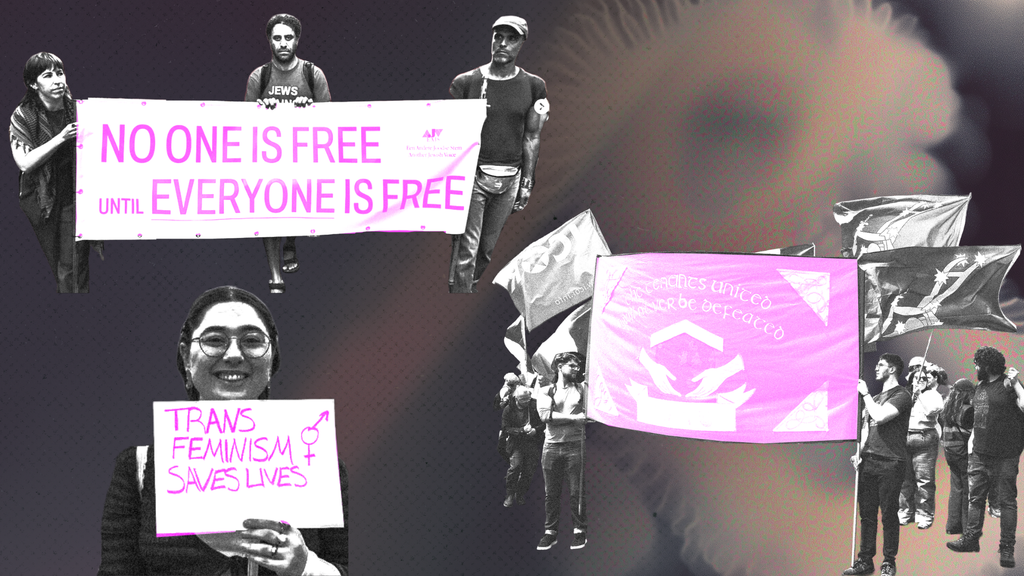
The Activist Council was conceived in 2022 with a two-year tenure. We quickly learned this was a bit naive. The onboarding required for activists to meaningfully participate in governance, let alone operationalise a participatory grantmaking pilot, demanded more time. So we extended the first generation’s mandate. In 2024, four new members replaced those who had left due to capacity constraints. But systematic renewal only began in earnest at the end of 2025. By mid-2026, most founding AC members will have stepped away. What they built will outlast them and that is precisely the point.
The lessons have been concrete. Good onboarding is slow. Participatory governance is not a design challenge you solve once; but a practice you sustain. And the AC, we now see, is being asked to hold two distinct roles: scouting and grantmaking on the one hand, governance participation on the other. The latter demands far deeper immersion, more time, more context, more appetite for institutional complexity. As our grantmaking budget grows, we will need more reviewers, but not necessarily more governance voices.
The likely evolution is a tiered model: space for those who want to make funding decisions without taking on the full weight of organisational governance, and space for those who want to shape strategy, sit in other circles, and carry the institution forward. Differentiation, done right, is not hierarchy but emerges as an acknowledgment that capacity is finite and participation must be meaningful to be legitimate.
- Financials
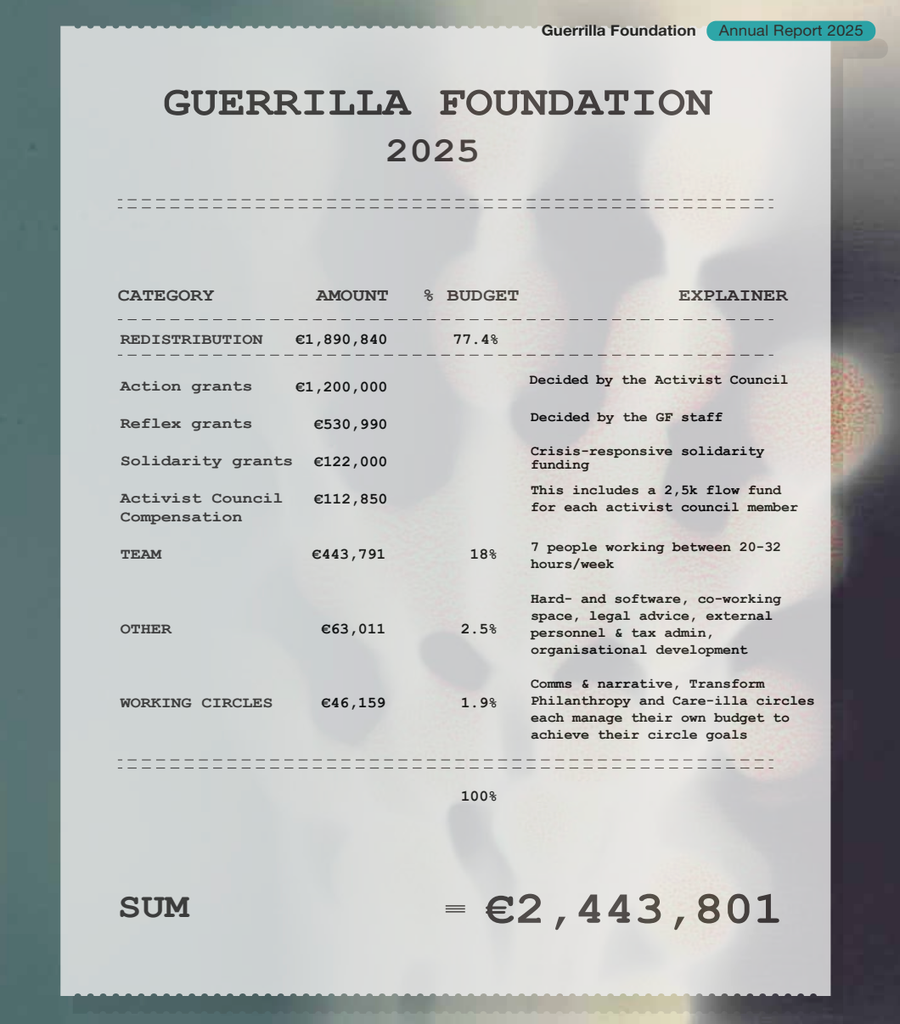
In 2025, we moved €1.91 million to the frontlines, 77.5% of our total budget, while keeping our own infrastructure lean: an 18% team cost for seven people working between 20 and 32 hours a week, and less than 2% each on operational overheads and circle-led work. The ambition is simple: more money, moved faster, to more activists who need it. Our appetite for degrowing amassed wealth is large, and the goal is to grow the budget until the numbers start being structural.