Against Perpetuity: The Case for Institutional Dissolution
Learning to Die Well So Movements Can Live.
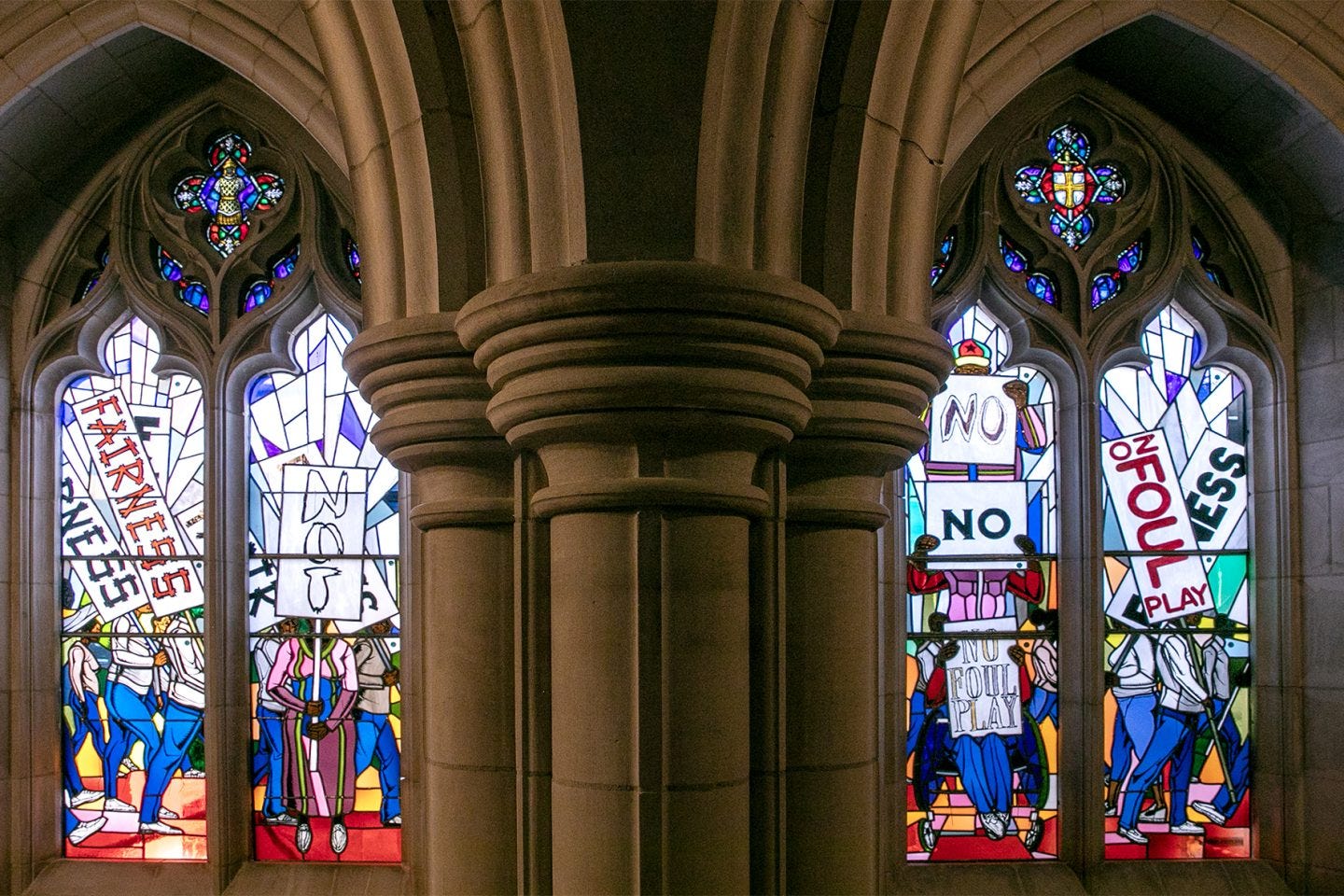
The cathedral of modern philanthropy is an architectural marvel of contradiction. Its spires are built from extracted wealth, its stained-glass windows depict the very communities that extraction dispossessed, and its foundation rests upon the assumption of permanence. For a century, the ultimate aspiration of any serious foundation was to exist in perpetuity, to become an eternal, unaccountable institution gently correcting the excesses of the economic system that birthed it. Into this cathedral, Farhad Ebrahimi, founder of the Chorus Foundation, has hurled a theological grenade. His core thesis, that spending down is not a moral purity test but a strategic intervention, demands we stop fetishizing the act of closing and start strategizing it. In Ebrahimi’s hands, and in the practice of a vanguard of radical funders, the sunset clause becomes a tool to de-risk radical giving, catalyze institutional capital, and seed a permanent economic engine for movements that renders grand philanthropic institutions obsolete.

To treat spending down as a mere moral decision is to trap oneself in a logic of personal absolution. The wealth holder, plagued by the cognitive dissonance of funding justice movements via returns from an extractive economy, decides to cleanse their guilt by zeroing out the balance sheet. This framing centers the donor’s emotional journey, not the movement’s strategic needs. Ebrahimi’s work at Chorus forcefully rejects this theatre. Spending down, as he conceptualizes it, is an act of systems architecture. It begins with the recognition that private philanthropy is a “transitional form”, a caterpillar that must facilitate the creation of butterflies rather than attempt to live forever as a caterpillar. When Chorus shifted from a vague intent to sunset “within my lifetime” to a hard 10-year plan, the decision was not driven by guilt; it was driven by the “urgency of the work” and a strategic analysis that hoarding resources for a distant future starves the present of the power needed to ensure a liveable future exists at all.
This urgency translates into a method for de-risking. Mainstream philanthropy is a fearful beast, terrified of funding the uncompromising, abolitionist edge of movements lest it offend board members or draw political heat. The spend-down foundation, liberated from the burden of preserving an endowment forever, can step into this breach and absorb that risk. Rather than a slow, dwindling retreat, the literature on sunset foundations reveals that these institutions can become what Hengevoss and von Schnurbein (2025) classify as “Impact Accelerators“ or “Urgency Responders“, strategic patterns where the final phase of a foundation’s life becomes its most potent, deploying concentrated capital to meet existential threats with existential speed.
Ebrahimi frames this as serving as “training wheels” for grantees, providing the high-risk, unrestricted capital that allows community organisations to build their own infrastructure and decision-making power. When a funder is exiting, it must ensure it does not leave a crater. The strategic spend-down thus obsesses over the final grantmaking phase, deliberately seeding community-controlled loan funds, land trusts, and permanent organising infrastructure so that local movements are no longer dependent on the whims of a distant foundation. The goal is to catalyze other institutional funders into following suit, demonstrating that bold, no-strings-attached funding does not trigger collapse but rather unlocks explosive, transformative capacity.
Chorus is far from alone in weaponising the sunset, though its transparency has made it a lodestar. Across the Atlantic, the Lankelly Chase Foundation’s decision to dissolve its £134 million endowment represented an escalation of this strategic logic, triggered by the board’s recognition that the foundation was “enmeshed in the very problem that we are trying to solve“, a function of colonial capitalism attempting to cure its symptoms. Julian Corner, its chief executive, articulated a clarity: rather than tinker with perpetuity, the foundation committed to wholly redistributing its assets over a five-year period, designing “controlled experiments” to hand decision-making power over resources to those imagining post-capitalist futures. This is a crucial semantic and strategic shift: the objective is not the annihilation of money but the abolition of the power structures that govern its flow. Lankelly Chase’s journey finds company in a growing cohort of UK trusts making similar choices. As Vivyan and Durham (2025) document in Voluntary Sector Review, foundations like the Gower Street Trust and the Sir Ernest Cassel Educational Trust are navigating their own spend-out processes, driven by the intertwined imperatives to spend more, give more flexibly, and shift power to the communities historically dispossessed by the very accumulation that endows them. These trusts build on the precedent of forerunners such as the Tubney Charitable Trust, the Polden Puckham Charitable Foundation, and the Old Dart Foundation, all of whom have chosen to reject institutional immortality in favour of timely, amplified impact. Smaller foundations, like the 30 Percy Foundation, have embarked on similar trajectories, aligning their final years with ceding full control, recognising that the foundation’s last and most potent act is its own decommissioning. This phenomenon is not a fringe anomaly but an emerging strategic pattern across international contexts, from the Atlantic Philanthropies‘ historic spend-down in Ireland to the MAVA Foundation‘s time-limited model in Switzerland, each instance offering distinct lessons in how a well-orchestrated sunset can generate a legacy that outlasts the institution itself.
The theoretical architecture supporting these experiments draws from a rich and growing body of scholarship that fundamentally challenges the legitimacy of perpetual philanthropy. Critical philanthropy studies have long illuminated how foundations function not as neutral arbiters of social goods but as instruments of “double dispossession” under racial capitalism, where accountability relations between donors and grantees reproduce the very racialized hierarchies that social justice organisations seek to dismantle. This literature reveals a bitter paradox: foundations bankrolled by processes of extraction and exploitation position themselves as the benefactors of the communities those processes most harm, all while retaining ultimate decision-making power over resource allocation. As a recent study in Human Relations demonstrates, the philanthropic accountability relationship enforces a partitioning, of leaders, of vision, of partners, that materially and symbolically deprives racial justice organisations, reproducing the political economy on which philanthropy’s own existence depends. This scholarly diagnosis makes the strategic sunset more than a tactical preference; it becomes a logical imperative for any foundation serious about advancing justice rather than managing its symptoms. The perpetual foundation finds itself caught in an inescapable contradiction, its existence predicated on the accumulation of wealth generated by the very systems of exploitation it purports to challenge. The critical literature makes clear that any intervention leaving the role of philanthropic grantmaking in the racial capitalist political economy intact, however well-intentioned, will not resolve this contradiction. The sunset, in this light, is the only honest exit from the feedback loop of injustice.
Yet spending down an endowment is only one expression of a deeper strategic orientation toward redistribution. Alongside these grand finales exists a parallel ecosystem of perpetual redistribution, embodied by non-endowed intermediaries like the Guerrilla Foundation, Dalan Fund, Collective Abundance, Weaving Liberation etc. Guerrilla, for instance, does not hoard a massive endowment, it grows in size precisely because of its redistribution model, continuously organising wealth-holders to degrow their hoarded assets in real-time. The foundation acts as a relay station, channeling capital from a Funders Circle of wealthy individuals into an Activist Council that makes the funding decisions. This model explicitly rejects the service culture of philanthropy, the idea that a donor writes a cheque and is thereby cleansed of responsibility. Instead, it demands donors engage in the political and personal work of redistribution as fundraisers, advocates & accomplices, while stripping them of unilateral decision-making power. Guerrilla’s growth proves that redistribution is not a recipe for organisational suicide but for building a robust, accountable infrastructure. We are not sunsetting our organisation; we are attempting to sunset the paternalistic donor-grantee hierarchy itself, demonstrating that real economic power can be built through a non-endowed, participatory model that actively organises against wealth accumulation.
These experiments collectively beg the existential question Ebrahimi poses: Are we here to manage scarcity, or to fund a world where we are no longer needed? The perpetual foundation is, by its very design, in the business of managing scarcity. It usually metes out a mere 5% of its assets annually, preserving the ‘phantom of the endowment’ for a future that will perpetually suffer the conditions the foundation was ostensibly created to solve. This is a circular economy of crisis in which the institution has a material stake in the continued existence of the social ills that justify its portfolio. The strategic spend-down breaks this loop. It treats the endowment not as a sacred trust but as fuel to be burned ferociously in a short window to achieve escape velocity from the gravitational pull of injustice. It converts financial capital into political power and infrastructure that, if done right, cannot be liquidated by a market downturn or a board vote.

We stand at a hinge in history where the scale of planetary precarity demands a commensurate scale of resource deployment that the safe 5% payout rule can never meet. Calls to reform philanthropy through impact investing or tokenistic participatory grantmaking, however elegant, ultimately amount to rearranging deck chairs on the Titanic if they leave the core power imbalance, the permanent, tax-sheltered hoarding of resources extracted from the commons, intact. The work of Farhad Ebrahimi, and the foundations bold enough to follow his lead, illuminates the exit ramp. They reveal that spending down is not the terminal illness of a foundation but the final, glorious expression of its purpose. It is the moment the caterpillar stops trying to optimise its endless larval existence and instead dissolves itself to fuel the collective, uncontrollable, and magnificent emergence of the butterfly. The only truly effective philanthropy is one that engineers the conditions of its own obsolescence, leaving behind not a gleaming endowment building but a liberated ecosystem of self-determining communities who no longer need to ask permission to survive. The clock is ticking, and the choice is finally as stark as it is exhilarating: manage the decline, or fund the ignition.

References
Ahmad A, Saifer B. The political economy of accountability: philanthropy’s ‘double dispossession’ of racial justice organizations under racial capitalism. December 18, 2024.
Ebrahimi F. How we got here. Stanford Social Innovation Rev. November 20, 2023.
Ebrahimi F. Where we need to go. Stanford Social Innovation Rev. November 20, 2023.
Ebrahimi F. We need a strategy for spending down. Stanford Social Innovation Rev. November 20, 2023
Hengevoss A, von Schnurbein G. All good things come to an end: emerging strategic patterns of sunset foundations. J Philanthr. 2025;30(1):e70015.
Henderson AL, Ebrahimi F. Strategic criteria for foundation spend-downs. Stanford Soc Innov Rev. 2024;22(1):44-51.
Vivyan S, Durham T. Spending more, giving more flexibly and shifting power: reflections from spend-out grant makers. Volunt Sector Rev. 2025;16(2):322-339.